Cash Offer vs. Reserve-Price Real Estate Auction: Which Is the Better Deal for Arizona Home Sellers in 2026?
A cash offer promises speed and convenience. A reserve-price auction invites competition with a seller-set minimum. Here is how Arizona home sellers can compare the two and decide which approach fits their situation.
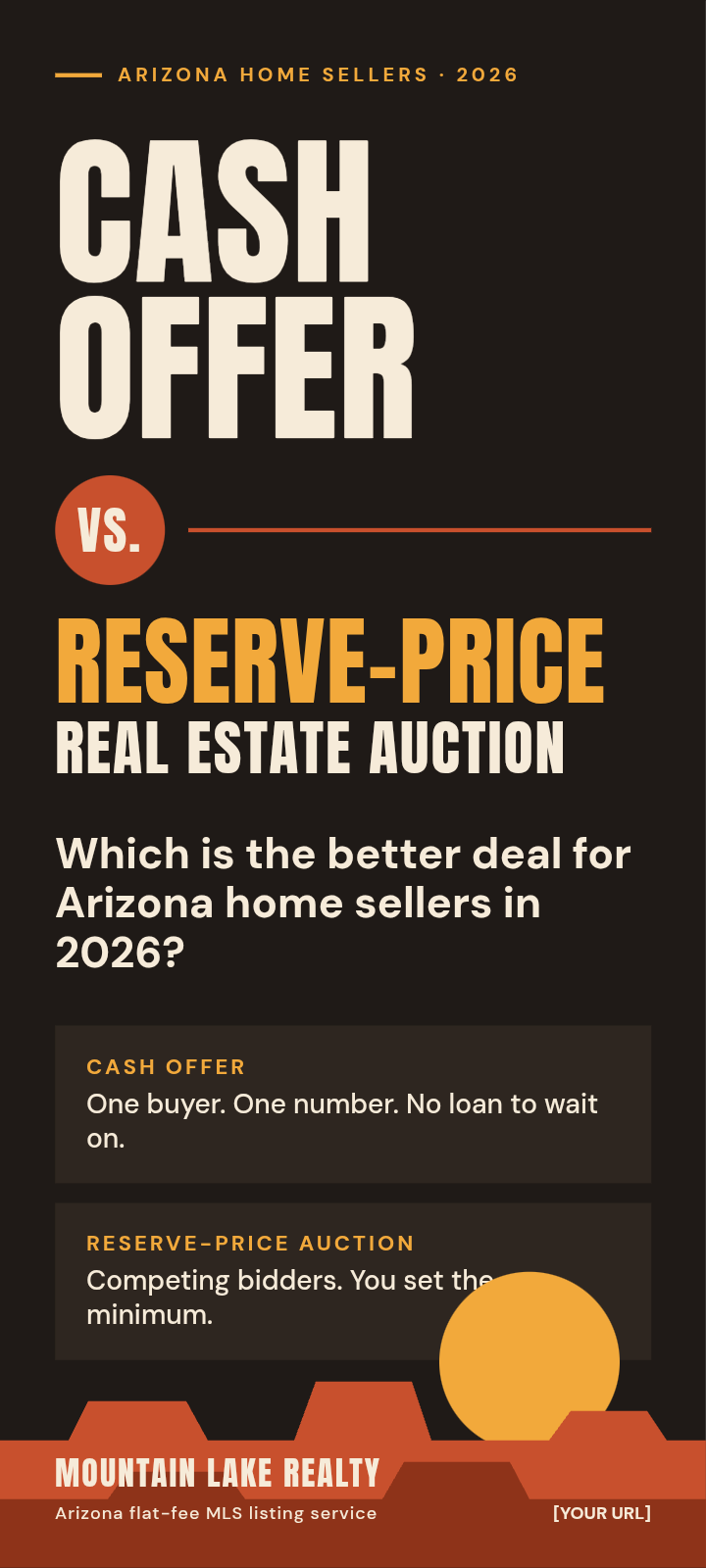
When selling a home in Arizona, receiving a cash offer can be tempting. There is no waiting for a buyer's mortgage approval, and the buyer may be willing to purchase the property as-is. For homeowners who want a quick, straightforward sale, that can be an attractive option.
But there is another approach worth considering: a reserve-price real estate auction with a confidential minimum acceptable price.
Instead of agreeing to one buyer's offer, a seller can market the property to multiple potential buyers and allow competitive bidding to help establish its market value. The seller establishes a reserve price in advance and generally retains the right not to sell if the bidding does not meet the required terms.
So which approach offers the better deal?
The answer depends on the cash offer, the property's marketability, the seller's timeline, the costs of each method, and the likelihood of attracting competing buyers.
1. How Does a Cash Offer Work?
A cash offer is a purchase proposal from a buyer who does not need a mortgage to fund the purchase. Cash buyers may include real estate investors, property companies, individuals with available funds, and other buyers seeking a direct transaction.
Many cash buyers value speed and convenience. In exchange, some expect to purchase the property below what they believe they could eventually resell it for.
Advantages of accepting a cash offer
- Potentially faster closing. Without mortgage underwriting, the transaction may close more quickly.
- Fewer financing concerns. The sale does not depend on the buyer obtaining a mortgage.
- Possible as-is sale. Some cash buyers are willing to purchase homes that need repairs.
- Convenience. There may be fewer showings and less preparation.
- Greater certainty once properly contracted. A cash buyer with verified funds and a well-written agreement may offer a relatively predictable closing.
Disadvantages of accepting a cash offer
- One buyer determines the price. You are negotiating with a single purchaser rather than inviting several buyers to compete.
- The offer may include a substantial discount. An investor typically evaluates the property's condition, carrying costs, resale potential, and desired profit.
- You may never discover what another buyer would pay. Accepting the first attractive offer can mean leaving potential proceeds unexplored.
- The offer is not automatically guaranteed. Buyers can still have contractual termination rights, title issues can arise, and closing can be delayed.
A cash offer is not necessarily a low offer. Some are competitive, and some sellers reasonably prefer certainty over the possibility of a higher price.
The important question is whether the convenience is worth the difference between the offer and what the property might generate through another selling method.
2. How Does a Reserve-Price Real Estate Auction Work?
A reserve-price auction offers a different approach to selling real estate.
The seller establishes a minimum acceptable sale price before the auction. Under a confidential-reserve format, that amount is not publicly disclosed to bidders.
The property is marketed to prospective buyers, who have an opportunity to submit competing bids during a defined auction period.
The National Association of REALTORS® describes a reserve auction as a format in which the highest bid is subject to seller confirmation rather than automatically resulting in a sale. The seller is not required to accept a bid that fails to satisfy the applicable reserve and auction terms.
Source: National Association of REALTORS® — Types of Auctions.
Advantages of a confidential reserve auction
- Potential competitive bidding. Multiple interested buyers may compete for the same property.
- Seller-defined price protection. The seller establishes the minimum acceptable price in advance.
- A defined marketing period. An auction can create a specific window for attracting interest and receiving bids.
- Price discovery. Bidding activity can help reveal how much qualified buyers are willing to pay.
- An alternative to a conventional listing. Some sellers prefer a structured auction campaign instead of an open-ended listing and repeated price reductions.
Disadvantages of a reserve auction
- A sale is not guaranteed. If bidding fails to meet the reserve, the seller may need to negotiate with the highest bidder or pursue another selling strategy.
- Competition must be generated. An auction cannot guarantee multiple bidders or a higher price.
- Marketing matters. Poor presentation, insufficient exposure, an unrealistic reserve, or limited buyer demand can undermine results.
- Costs and terms vary. Sellers should understand auction fees, marketing expenses, contract provisions, buyer premiums, and closing costs before proceeding.
A reserve auction is not the same as an absolute auction. In an absolute auction, the property is generally sold to the highest bidder regardless of price. A reserve auction preserves the seller's ability to reject an insufficient bid, subject to the agreement and applicable law.
3. Cash Offer vs. Reserve Auction: A Side-by-Side Comparison
| Consideration | Cash offer | Confidential reserve auction |
|---|---|---|
| How the price is established | Negotiation with a buyer | Competitive bidding, if buyers participate |
| Potential closing speed | Often fast | Depends on auction and closing terms |
| Financing risk | No buyer mortgage required | Depends on the winning bidder's funding |
| Minimum acceptable price | Negotiated through the offer | Established by the seller as the reserve |
| Guaranteed sale? | No, until contractual obligations are fulfilled | No, if the reserve is not met |
| Potential for price competition | Usually limited to the negotiation | Multiple buyers may compete |
| Repair flexibility | Some buyers accept as-is | Sale terms can be structured for the property's condition |
| Main attraction | Convenience and speed | Potential competition and seller price protection |
| Main risk | Accepting less than another buyer might pay | Insufficient bidding or no completed sale |
Neither method is automatically superior. The better choice is the one that produces the best combination of net proceeds, timing, certainty, and convenience for the individual seller.
4. A Real-World Example: A $600,000 Arizona Home
Consider an Arizona homeowner whose property has an estimated market value of approximately $600,000.
The seller receives a cash offer of $540,000. The buyer offers a convenient transaction with a relatively short closing timeline.
Should the seller accept?
Before deciding, the homeowner could compare the offer with a professionally structured reserve-price auction.
Here is an illustrative comparison using hypothetical numbers, not actual market results:
| Scenario | Cash offer | Reserve auction |
|---|---|---|
| Sale price | $540,000 | $600,000 |
| Illustrative selling costs | $5,000 | $15,000 |
| Net before mortgage payoff and other expenses | $535,000 | $585,000 |
In this example, the auction produces $50,000 more before mortgage payoff and other expenses.
But the outcome could be different. The auction might generate only $550,000 in bidding, or the reserve might not be met at all. The cash buyer might also improve the original offer.
The comparison illustrates why sellers should evaluate net proceeds rather than just the headline price.
A useful calculation is:
Net proceeds = Sale price − selling expenses − applicable concessions − other transaction costs.
The seller should also consider the cost of waiting, including property taxes, insurance, utilities, maintenance, loan payments, and any expenses incurred while the property remains unsold.
If the auction produces a higher price but takes longer or incurs additional expenses, those differences should be included in the comparison.
5. Why Keep the Reserve Price Confidential?
A confidential reserve price can give a seller flexibility during an auction.
If the seller publicly announces the minimum acceptable price, some buyers may treat that figure as a target rather than compete beyond it. Other buyers may decide the property is outside their budget before exploring its value.
With a confidential reserve, interested buyers can submit bids based on their own assessments of the property and their desire to acquire it.
There is an important qualification: keeping the reserve confidential does not automatically create competition or produce a higher sale price.
Buyers need sufficient information to evaluate the property, and the marketing must reach an appropriate audience. The reserve also needs to be realistic relative to market conditions and likely buyer demand.
Auction rules should clearly explain what happens when the reserve is met, what happens when it is not met, and whether the seller retains any approval rights.
6. When Is a Cash Offer the Better Choice?
A cash offer may be the more practical option when:
- The seller must close quickly because of a relocation or other deadline.
- The property needs substantial repairs and the buyer offers acceptable terms.
- The seller has limited time or resources for a marketing campaign.
- The cash offer is competitive with the property's realistic market value.
- The seller places a high value on convenience and a predictable timeline.
For example, a homeowner who must move within two weeks may reasonably choose a strong cash offer over an auction that requires a marketing period and additional time to close.
The right decision does not always mean pursuing the highest possible price. Sometimes certainty and timing are worth more.
7. When Is a Reserve-Price Auction Worth Considering?
A reserve auction may be worth exploring when:
- The seller is not under extreme time pressure.
- The property could appeal to several potential buyers.
- The seller wants to test buyer demand through competitive bidding.
- The homeowner has a clear minimum acceptable price.
- The seller wants a defined marketing campaign rather than an indefinite listing period.
- A unique property, desirable location, or distinctive feature could attract competing purchasers.
This can be particularly relevant for properties where market value is difficult to establish precisely or where different buyers may place different values on the same home.
However, an auction should not be treated as a guaranteed way to beat the market. The quality of the property, pricing expectations, marketing reach, and buyer participation remain critical.
8. What Should Arizona Sellers Ask Before Choosing?
Whether you are considering a cash buyer or an auction, ask these questions before committing.
For a cash offer:
- Has the buyer provided credible proof of available funds?
- What contingencies or termination rights does the contract contain?
- Who pays closing costs, title expenses, and other transaction charges?
- Is the offer subject to inspections, repairs, or renegotiation?
- What is the proposed closing date?
For a reserve-price auction:
- What is the total cost to the seller?
- How will the property be marketed to potential buyers?
- Is the reserve confidential, and who knows the amount?
- What happens if the reserve is not met?
- Is there a buyer's premium, and how does it affect the buyer's total cost?
- What deposit, financing, inspection, and closing requirements apply?
- Can the seller pursue another strategy if the auction does not result in an acceptable offer?
Arizona sellers should also review the auction agreement, purchase contract, title requirements, and applicable disclosure obligations carefully. The terms of the particular auction matter more than the label used to describe it.
9. The Bottom Line: Compare the Cash Offer With the Auction's Potential Net
A cash offer provides a specific price from a specific buyer. A reserve-price auction offers an opportunity to test demand while protecting the seller's minimum acceptable price under the agreed auction terms.
If speed and convenience are the priorities, a strong cash offer may be the better deal.
If the seller has time to market the property and believes several buyers could compete, a reserve-price auction may offer an opportunity to achieve a better result.
Before accepting a cash offer, consider comparing it with a realistic estimate of the proceeds from an auction. Review the costs, the likely timeline, and the risks of both approaches.
The goal is not simply to sell quickly or to obtain the highest advertised price. It is to choose the selling method that best serves your financial objectives.
Explore a Non-Distressed Real Estate Auction in Arizona
Arizona homeowners do not have to assume that an auction is only for foreclosures, distressed properties, or homes facing financial difficulties.
A properly planned real estate auction can be considered as an alternative selling strategy for a property that its owner wants to sell on acceptable terms.
Learn more about non-distressed property auctions and reserve-price options for Arizona homes, or contact us to discuss your selling situation.
Explore Topics
Written by
Dash List Team at Mountain Lake Realty
Content creator and writer sharing insights and stories.