Upcoming Appraisal Changes in 2026: What Arizona Home Sellers Should Know
Fannie Mae and Freddie Mac are mandating UAD 3.6 and redesigned appraisal reports on November 2, 2026. Here is what Arizona sellers need to understand before listing — and how to prepare.
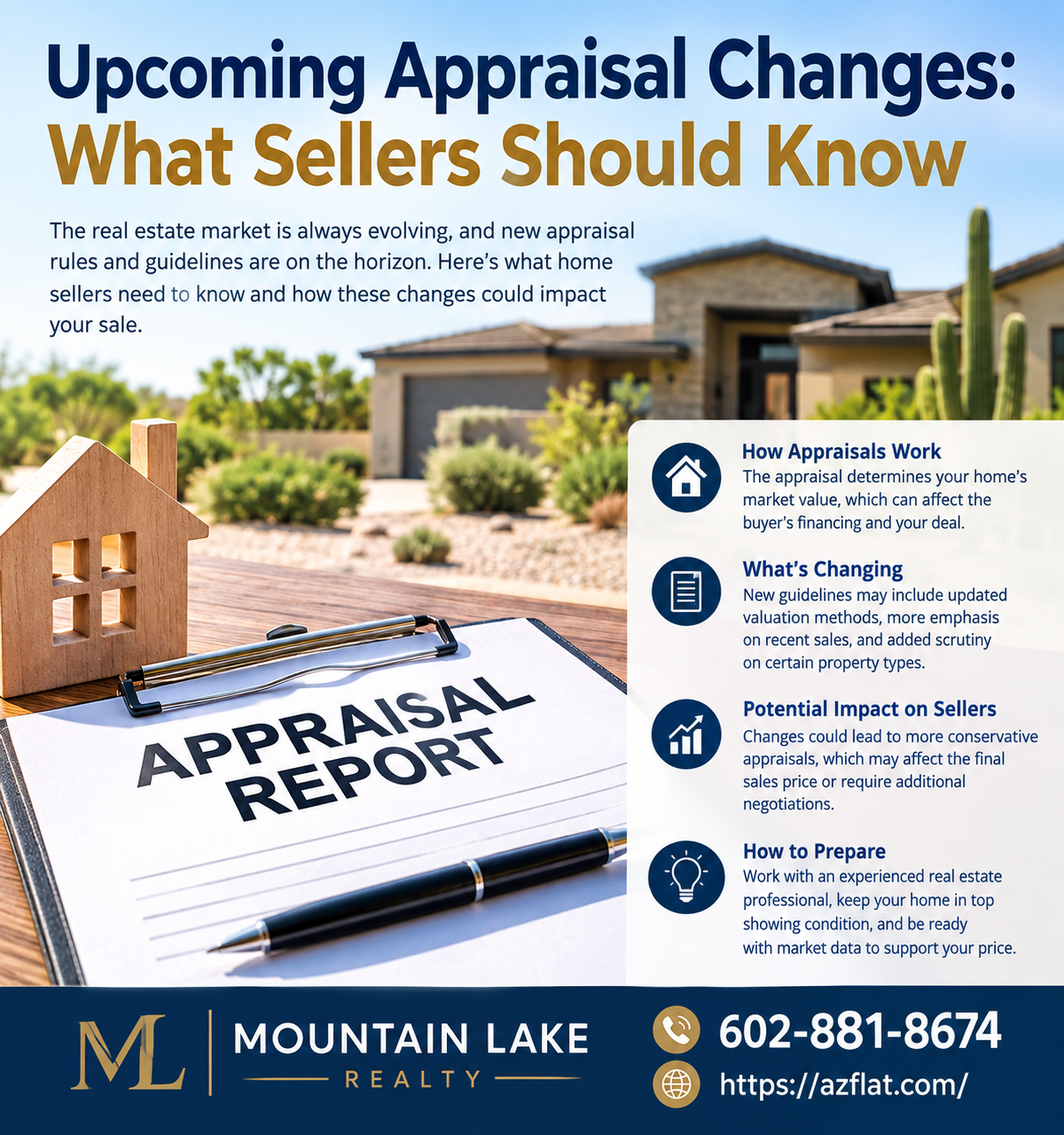
Home sellers should be aware of a major change taking place in the residential appraisal industry this fall.
Fannie Mae and Freddie Mac are transitioning to the Uniform Appraisal Dataset (UAD) 3.6 and redesigned appraisal reporting. The new system is designed to create more consistent, detailed, and data-driven appraisal reports.
The transition has been underway throughout 2026, and November 2, 2026 is the scheduled mandate date for new appraisal reports submitted through the GSE system.
For homeowners preparing to sell, this does not mean that every property will suddenly receive a different value. However, it does mean that sellers should understand how appraisals are evolving — and why accurate property information is becoming increasingly important.
What Is UAD 3.6?
The Uniform Appraisal Dataset (UAD) 3.6 is an updated data standard developed by Fannie Mae and Freddie Mac. The redesign replaces the traditional appraisal forms with a more flexible, dynamic reporting format intended to provide more standardized property information.
Fannie Mae says the redesign is intended to improve the quality and consistency of appraisal data while supporting a more modern, data-driven appraisal process.
UAD 3.6 entered broad production in January 2026, allowing lenders to begin using the new appraisal format before the November mandate.
What Changes for Sellers?
Most sellers will not be responsible for completing the new appraisal report — that remains the job of the appraiser and lender. However, sellers can help make the appraisal process easier by ensuring important information about the property is accurate and readily available.
1. Property Details Matter
Appraisals depend heavily on accurate information about the property. The new UAD 3.6 system is designed to capture more standardized property information, making it especially important for sellers and listing agents to provide accurate details rather than relying on outdated or incomplete property descriptions.
Key details appraisers rely on include:
- Finished living area and square footage
- Number of bedrooms and bathrooms
- Garage and parking
- Lot size and characteristics
- Property condition and age
- Recent improvements and remodeling
- Energy-efficient features and solar
- Accessory dwelling units (ADUs)
- Pools and other significant improvements
- Comparable sales in the area
2. Measurements Continue to Be Important
Square footage can have a significant impact on how comparable properties are analyzed. Fannie Mae has updated its appraisal policies to align with ANSI Z765-2021 measurement terminology, including terminology distinguishing above-grade and below-grade finished areas.
For sellers, this is another reason to make sure the advertised square footage is supported by reliable property information. If you have added an addition, enclosed an area, converted space, or completed another major improvement, documentation is particularly useful.
3. Remodeling and Improvements Should Be Documented
Before an appraisal, create a simple list of significant improvements. For example:
| Improvement | Year Completed |
|---|---|
| New roof | 2024 |
| New HVAC system | 2025 |
| Kitchen remodeling | 2025 |
| New flooring | 2026 |
| Pool improvements | 2026 |
| New windows | 2024 |
| Solar installation | 2025 |
Receipts, permits, warranties, and contractor documentation can also be useful when available. The goal isn't to tell an appraiser what value to assign — it's to make sure the appraiser has accurate information about the property being evaluated.
4. Comparable Sales Remain Critical
Comparable properties — commonly called "comps" — remain one of the most important parts of a residential appraisal. Fannie Mae has emphasized that appraisers should analyze whether market conditions have changed between the time a comparable goes under contract and the effective date of the appraisal, making time adjustments when supported by the analysis.
For sellers, this reinforces an important point: the most recent sale is not automatically the best comparable. Differences in location, size, condition, upgrades, lot characteristics, and market timing can all matter.
5. Accurate Listing Information Becomes Even More Important
A home's MLS listing contains a substantial amount of information that helps buyers, lenders, and appraisers understand the property. Sellers should review the listing carefully for errors before going live.
Double-check:
- Square footage
- Bedroom and bathroom count
- Garage spaces
- Lot size and year built
- Improvements and pool information
- Property type and HOA information
- Special features and views
Incorrect information can create unnecessary complications later in the transaction — and with UAD 3.6 capturing more standardized data, discrepancies are more likely to surface.
Could the New Appraisal System Make Appraisals More Accurate?
The purpose of UAD 3.6 is to improve the consistency and quality of appraisal data. However, sellers should not assume the new system automatically means a higher or lower appraisal.
The value of a home is still dependent on the property's characteristics, comparable sales, market conditions, and the appraiser's analysis. The new reporting system changes how information is collected and reported — it does not establish a guaranteed value for a property.
What About AI and Automated Valuation Models?
Technology is becoming increasingly important in real estate valuation. Automated valuation models (AVMs), property databases, and statistical analysis tools can help lenders and real estate professionals analyze property information.
However, an automated estimate is not the same thing as a traditional appraisal. Homeowners should be cautious about assuming that an online estimate, Zestimate, or other computer-generated number represents the price a buyer will pay or the value a lender will accept.
The actual appraisal process involves physical inspection, comparable-sales analysis, market-condition analysis, and other factors that no algorithm fully replicates.
What Sellers Can Do Before Listing
Create a Property Improvement File
Gather documentation for:
- Remodeling projects (kitchen, bathrooms, flooring)
- Roof and HVAC replacement
- Windows, solar systems, and landscaping
- Additions, permits, and major repairs
- Pool improvements
Having this information available makes it easier to provide accurate details during the transaction — and gives the appraiser the full picture of your home's condition and improvements.
Don't Overprice Because of Online Estimates
Online home-value estimates can be useful as a starting point, but sellers should not rely on a single computer-generated estimate when determining an asking price. A successful pricing strategy should consider current comparable sales, competing listings, market conditions, property condition, and buyer demand.
Remember: the seller determines the asking price. The market determines what buyers are willing to pay. The appraiser provides an independent opinion of value for the intended lending purpose. These are three different numbers.
What Happens If the Appraisal Comes in Low?
A low appraisal can create complications when the buyer is obtaining financing. For example:
- Contract price: $500,000
- Appraised value: $480,000
The lender may base the loan on the appraised value, not the contract price. This can leave a $20,000 gap that must be resolved through renegotiation, a price reduction, the buyer making up the difference in cash, or — in some cases — a cancelled transaction.
The best protection against a low appraisal is accurate pricing from the start. A home priced at or near market value, supported by recent comparable sales, is far less likely to face an appraisal gap than one priced aspirationally above the market.
The Bottom Line for Arizona Sellers
The November 2026 UAD 3.6 mandate is a back-end change to how appraisal data is collected and reported — not a fundamental shift in how homes are valued. But it does reinforce the importance of accurate property information, documented improvements, and realistic pricing.
How to prepare for the appraisal when selling your Arizona home
Whether or not UAD 3.6 affects your specific transaction, here is how to prepare for the appraisal process:
Before the appraisal
Gather documentation of improvements. Appraisers give credit for improvements when they are documented. Compile receipts, permits, and contractor invoices for any significant work you have done — kitchen remodel, bathroom update, new HVAC, roof replacement, pool addition.
Prepare a list of features and upgrades. Create a one-page summary of your home's key features and recent improvements. Include square footage, room count, lot size, year built, and any upgrades. Leave it for the appraiser.
Research comparable sales. Know what similar homes in your neighborhood have sold for in the last 90 days. If you believe the appraiser has missed a relevant comparable, you can provide it — appraisers are required to consider comparables you submit.
Price accurately. The most common reason appraisals come in below the purchase price is that the home was overpriced. If your home is priced at market value, the appraisal should support it.
During the appraisal
Be present but not intrusive. You can be home during the appraisal, but give the appraiser space to work. Answer questions honestly and provide the documentation you have prepared.
Point out improvements that may not be obvious. If you have replaced the HVAC, upgraded the electrical panel, or added insulation, mention it. These improvements add value but may not be visible to the appraiser.
Do not pressure the appraiser. Appraisers are required to be independent. Attempting to influence the appraisal can backfire and may be considered a violation of appraisal standards.
After the appraisal
Review the report carefully. If the appraisal comes in below the purchase price, review the report for errors — incorrect square footage, missing rooms, wrong comparable sales. Errors can be corrected through a reconsideration of value request.
Understand your options. If the appraisal is below the purchase price, you have several options: reduce the price to the appraised value, ask the buyer to make up the difference in cash, negotiate a split, or cancel the contract (if the buyer has an appraisal contingency).
Consider a second appraisal. If you believe the first appraisal was inaccurate, you can request a second appraisal. This is more common in luxury transactions where comparable sales are limited.
The appraisal gap: what it is and how to handle it
An appraisal gap occurs when the appraised value comes in below the purchase price. This is more common in competitive markets where buyers have bid above asking price.
For example, if a buyer offers $480,000 on a home that appraises at $460,000, there is a $20,000 appraisal gap. The buyer's lender will only lend based on the appraised value ($460,000), so the buyer must either:
- Pay the $20,000 gap in cash (in addition to their down payment)
- Negotiate a price reduction to $460,000
- Walk away (if they have an appraisal contingency)
As a seller, you can protect yourself from appraisal gaps by:
- Pricing accurately based on current comparable sales
- Including an appraisal gap coverage clause in the contract (common in competitive markets)
- Requiring proof of funds for the gap amount before accepting an offer
If you're preparing to list your Arizona home, Dash List puts your property on the MLS for $59 upfront plus 0.5% at closing — with full broker support through closing, including contract review and transaction guidance. See our packages or schedule a free consultation.
Explore Topics
Written by
Thomas Mastromatto, Broker
Content creator and writer sharing insights and stories.