
Who Pays the Buyer\'s Agent? A Complete Guide to BAC for Arizona Home Sellers and Buyers
Buyer\'s agent compensation (BAC) has changed. Learn who pays the buyer\'s agent in Arizona, what sellers are and aren\'t required to do, and how to avoid surprises at closing.
If you have bought or sold a home in the last few years, you have probably noticed that the conversation around real estate commissions sounds very different than it used to. One acronym sits at the center of that conversation: BAC, short for Buyer's Agent Compensation.
For decades, most people assumed the answer to "who pays the buyer's agent?" was simple: the seller did, automatically, as part of a commission built into the listing. That assumption is no longer a safe one. Rules about how compensation is offered, displayed, and agreed upon have shifted, and both sides of a transaction are now expected to talk about it openly.
This guide explains what BAC is, how it works today, and what Arizona sellers and buyers should know before they list, tour, or make an offer. We will walk through five key points, answer the question that every seller eventually asks, and finish with practical steps you can use right away.
A quick note before we begin: this article is for general education and is not legal advice. Rules and forms can change, so confirm the details for your own situation with a licensed Arizona real estate professional or an attorney.
What Is BAC (Buyer's Agent Compensation)?
Buyer's Agent Compensation is simply the payment a buyer's real estate agent receives for representing the buyer in a purchase. That representation includes a lot of work: searching for homes, scheduling and attending showings, analyzing comparable sales, writing and negotiating offers, coordinating inspections and the appraisal, and guiding the buyer through to closing.
The important question has never been whether a buyer's agent gets paid. They do. The question is who pays, how much, and how that gets agreed upon.
Historically, compensation for the buyer's agent was typically offered by the listing side and displayed in the Multiple Listing Service (MLS), the database that real estate professionals use to share listings. Because it was displayed and routine, many consumers never thought about it. It was simply "how it worked."
Today the process is more transparent, and more negotiable. That is why every buyer and seller benefits from understanding BAC before they ever sign a document.
Why BAC Has Become Such a Big Topic
The national conversation about commissions changed significantly following a landmark legal settlement involving the National Association of REALTORS® (NAR). Practice changes tied to that settlement took effect in August 2024 and reshaped how buyer's agents are compensated and how that compensation is communicated.
Without getting lost in the legal details, three shifts matter most to everyday sellers and buyers:
- Compensation offers can no longer be advertised through the MLS. Listings on the MLS are no longer the place where a seller's offer of buyer-agent compensation is published.
- Buyers are expected to have a written agreement with their agent. Before touring homes with an agent, buyers generally need to sign an agreement that spells out what the agent will do and how they will be paid.
- Compensation is explicitly negotiable. Neither side should assume a set percentage. Amounts are agreed upon between the parties.
The result is a market where the money conversation happens earlier and more directly. For people who feel comfortable with clarity, that is good news. For people who were never told this was negotiable, it can feel like a surprise. The goal of this guide is to make sure you are never surprised.
Point 1: Sellers Are Not Required to Pay BAC
This is the point that surprises many homeowners the most: sellers are not required to pay buyer's agent compensation.
There is no law that says a seller must pay the agent who represents the buyer. Paying, or offering to pay, is a business decision, not an obligation. A seller who lists their home can choose to offer compensation to the buyer's agent, offer a partial amount, or offer nothing at all.
Why does this matter? Because for many years, sellers who were never told they had a choice simply accepted a bundled commission that included an amount for the buyer's side. Understanding that BAC is optional gives sellers a powerful starting point for pricing their home, planning their net proceeds, and deciding how to compete in their local market.
That said, "not required" does not automatically mean "not wise." We will come back to the strategy of whether to offer compensation shortly. For now, the key takeaway is that the choice belongs to you.
Point 2: Buyers Agree to Compensation With Their Agent
The second key point flips the old assumption on its head: buyers agree to compensation directly with their own agent.
Under current practices, a buyer who wants professional representation sits down with an agent and signs a written buyer representation agreement. That document typically spells out the services the agent will provide, the length of the agreement, and, importantly, how and how much the agent will be paid.
This is a healthy change for buyers in several ways:
- Transparency. You know exactly what your agent earns before you begin touring homes.
- Negotiation power. Because compensation is an agreed term, buyers can ask questions, compare agents, and discuss structure.
- Aligned expectations. The agent knows what the engagement covers, and the buyer knows what they are getting.
Buyers should read any representation agreement carefully and ask about anything unclear: how long the agreement lasts, what happens if the agent is paid by the seller, and what happens if the seller offers less than the agreed amount. A good agent will welcome these questions.
Point 3: Sellers Can Still Cover Some or All of It
Here is where the picture gets balanced. Even though sellers are not required to pay BAC, sellers can still choose to cover some or all of it.
Many sellers do exactly that, because it can make their home more attractive to buyers. Think about it from the buyer's perspective. A buyer who has just stretched to afford a down payment, closing costs, and moving expenses may not have extra cash to pay an agent out of pocket. If a seller offers to help with buyer-agent compensation, that buyer may find the home more accessible than a similar one where no help is offered.
There are several common ways this plays out:
- The seller offers a set amount or percentage to the buyer's agent as part of the deal.
- The seller offers a credit to the buyer (often called a seller concession) that the buyer can apply toward closing costs, which may include their agent's fee.
- The seller and buyer negotiate it as part of the offer, treating compensation as one piece of the overall price and terms.
None of these approaches is automatically right or wrong. The best choice depends on your local market, your home's appeal, how quickly you need to sell, and your financial goals. The important thing is that it is a deliberate decision, not a default.
Point 4: BAC Is No Longer Advertised Through the MLS
The fourth point is a practical one: BAC is no longer advertised through the MLS.
In the past, a buyer's agent could look at an MLS listing and immediately see what compensation the seller was offering. That visibility is gone from the MLS itself. Sellers who want to offer compensation can still do so, but it is communicated outside the MLS, through direct conversations, written agreements, or negotiated terms in the offer.
What does that mean in real life?
- Sellers should decide their approach before listing. If you plan to offer compensation, think through the amount and how you will communicate it to interested buyers and their agents.
- Buyers should ask directly. Do not assume a listing includes or excludes compensation. Your agent can ask the listing side what the seller is willing to do.
- Agents should have clear conversations early. Open communication prevents last-minute disagreements.
This is also why working with a listing service that understands the new landscape matters. A well-prepared seller can explain their position confidently when a buyer's agent calls, rather than scrambling to figure it out mid-negotiation.
Point 5: Clarity Early Helps Avoid Surprises Later
If there is one theme that runs through every change in this space, it is this: clarity early helps avoid surprises later.
Most frustrating real estate moments come from misunderstandings that surfaced too late. A buyer discovers at the offer stage that they owe their agent money they did not expect. A seller learns during negotiation that buyers are asking for help with agent fees. A closing is delayed because everyone assumed someone else was handling a cost.
All of these are avoidable with early, honest conversations. Here is a simple framework.
For sellers:
- Decide whether you are willing to offer buyer-agent compensation, and in what range.
- Understand how that choice affects your estimated net proceeds.
- Be ready to discuss it, and to negotiate it, when offers come in.
For buyers:
- Interview agents and ask exactly how they are paid.
- Read your representation agreement before signing.
- Include compensation in your overall budget, alongside your down payment and closing costs.
When everyone knows the plan, the transaction runs smoother, and the relationships involved stay positive.
Point 6: The Question Every Seller Asks
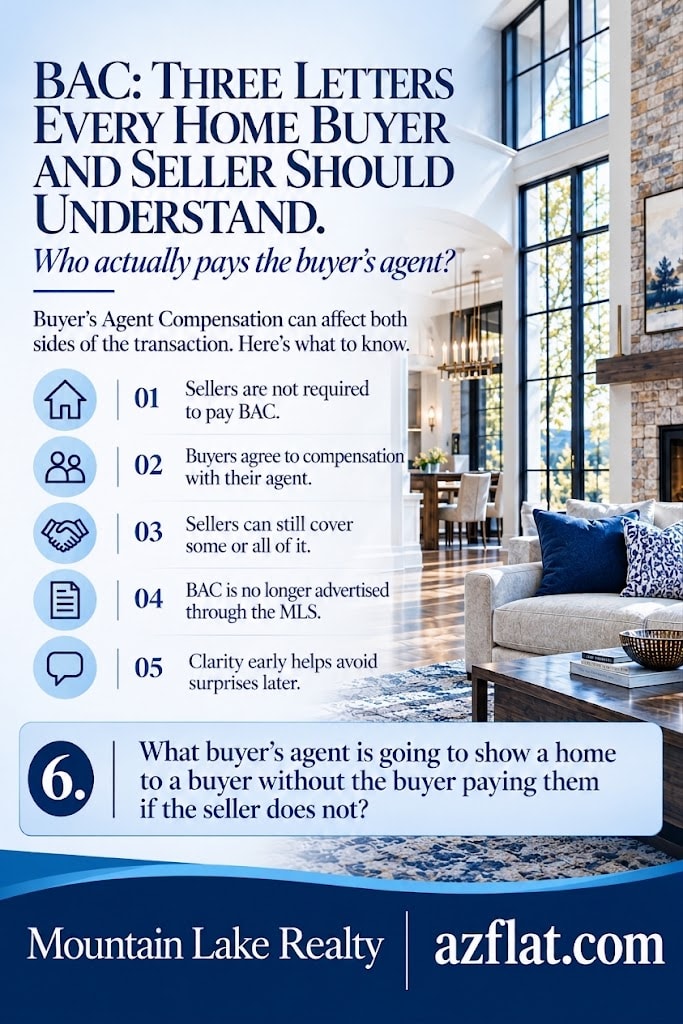
The infographic that inspired this article closes with a sixth point, phrased as a question that nearly every seller has wondered about:
What buyer's agent is going to show a home to a buyer without the buyer paying them if the seller does not?
It is a fair question, and it deserves an honest, balanced answer.
The reality is that real estate agents are professionals who work for compensation. Under current practices, a buyer's agent is expected to have an agreement with their client about how they will be paid. So the practical question becomes: where will that payment come from?
There are really three possibilities:
- The seller offers compensation, and the buyer's agent is paid at least in part from that offer.
- The buyer pays their agent directly, according to the written agreement they signed.
- The two share it, often through a negotiated seller concession or credit.
If a seller offers nothing, some buyers will pay their agent themselves, and others may choose to focus on homes where the seller is offering help. In a market with plenty of buyers and limited inventory, a seller offering nothing may lose very little. In a slower market, or for a home that needs to stand out, offering some compensation may widen the pool of interested buyers.
There is no universal answer, and anyone who tells you otherwise is oversimplifying. The smart approach is to look at your local market, your timeline, and your goals, and make a decision with open eyes.
How Flat-Fee MLS Listings Fit Into the Picture
This is where many Arizona sellers find real value. A flat-fee MLS listing lets a homeowner get their property on the MLS for a set, upfront fee rather than paying a traditional percentage-based listing commission.
Because BAC is now a separate, negotiable decision, the flat-fee model fits naturally with the way the market works today:
- You control the cost of listing. A flat fee means your listing cost is known upfront and does not scale with your sale price.
- You decide your BAC strategy. You choose whether to offer compensation to the buyer's agent, how much, and in what form.
- You keep MLS exposure. Your home can still appear in the database that buyers' agents and major real estate websites rely on.
Flat-fee service levels vary by company, so it is worth reading exactly what is included: listing photos, yard signs, lockboxes, showing coordination, offer support, and help with contracts and closing paperwork. Mountain Lake Realty, an Arizona-licensed brokerage, provides flat-fee MLS listing services to sellers across the state, and sellers can explore options at azflat.com.
Whichever provider you choose, ask them how they handle questions from buyer's agents about compensation, and make sure you understand who is responsible for those conversations.
Strategies for Arizona Sellers
Arizona is a diverse market. A home in the Phoenix metro area, a retirement community in Prescott, a vacation property near a lake, and a rural parcel all behave differently. Here are strategies that sellers can adapt to their own circumstances.
1. Know your local market conditions
How many comparable homes are for sale? How quickly are they selling? In a fast-moving market, buyers have fewer alternatives and sellers hold more leverage. In a slower market, incentives matter more.
2. Calculate your net proceeds under several scenarios
Before you list, run the numbers three ways: offering no BAC, offering a partial amount, and offering a fuller amount. Seeing the difference in your take-home helps you decide with confidence.
3. Consider offering compensation as a marketing tool
If your goal is the widest possible buyer pool, offering some assistance can make your home accessible to buyers who are cash-constrained at closing. Think of it as part of your pricing and marketing strategy.
4. Be prepared to negotiate
Even if you decide not to advertise or offer compensation up front, buyers may request help with agent fees or closing costs in their offer. Decide in advance how you would respond.
5. Put everything in writing
Whatever you agree to, make sure it is clearly documented in the purchase contract or related paperwork so there is no confusion at closing.
6. Choose a listing partner who explains, not just sells
The best partners will walk you through your options, answer your questions plainly, and help you communicate your position to buyer's agents.
Tips for Arizona Home Buyers
Buyers have an equally important role in this new landscape. Here is how to protect yourself and get the most from your agent relationship.
- Ask about compensation up front. A professional agent will be happy to explain how they are paid and what happens in different scenarios.
- Understand your written agreement. Know the length of the agreement, the services included, and how it can be changed or ended.
- Budget for it. If you may be responsible for some or all of your agent's compensation, include it in your total cost planning.
- Ask your agent to request seller help. Sellers may be willing to contribute, especially if it helps close the deal. It never hurts to ask.
- Compare homes on total cost. A slightly higher price with a seller concession might cost less overall than a lower price with nothing offered. Look at the whole picture.
- Talk to your lender early. Lenders have rules about what seller contributions can cover and how much, so check how any concession fits your loan.
Common Myths About BAC
Myth: Sellers must always pay the buyer's agent. Fact: Sellers are not required to pay BAC. It is their choice.
Myth: Buyers never have to pay their agent anything. Fact: Buyers agree to compensation with their own agent, and in some cases may pay part or all of it directly.
Myth: If I do not offer BAC, no one will show my home. Fact: Many buyers and agents will still engage, but the pool of interested buyers can be affected by your market and your approach. It is a strategic decision.
Myth: Commissions are set by law. Fact: Compensation is negotiable. No fixed rate is required.
Myth: The MLS still shows what the seller is offering. Fact: BAC is no longer advertised through the MLS, so it requires direct communication.
Frequently Asked Questions
Who pays the buyer's agent in Arizona? It depends on the agreement. A seller may choose to offer compensation, the buyer may pay their agent directly, or the two may share the cost through a negotiated concession. Sellers are not required to pay.
Can a seller refuse to pay the buyer's agent? Yes. A seller is not required to pay BAC. Buyers who work with an agent will then need to arrange payment under their own agreement, or negotiate with the seller.
Is buyer's agent compensation negotiable? Yes. There is no required or standard rate. Amounts are agreed upon by the parties involved.
Can a buyer ask the seller to cover their agent's fee? Yes. Buyers can include a request for seller assistance in their offer. Whether the seller agrees is a matter of negotiation.
Why isn't BAC shown on MLS listings anymore? Following the practice changes that took effect in August 2024, offers of compensation are no longer published through the MLS. Compensation is now discussed and agreed upon outside of it.
Does a flat-fee MLS listing still get exposure to buyers? Yes. A flat-fee MLS listing places your home in the MLS, where buyers' agents and popular real estate websites find listings. Confirm the specifics with your provider.
Do I need a written agreement to work with a buyer's agent? Under current practices, buyers are generally expected to sign a written agreement with their agent before touring homes together. Ask your agent for the exact requirements and terms.
Key Takeaways
The BAC conversation can feel complicated, but it boils down to a handful of clear ideas:
- Sellers are not required to pay BAC.
- Buyers agree to compensation with their agent.
- Sellers can still cover some or all of it, and often it makes strategic sense.
- BAC is no longer advertised through the MLS — it requires direct communication.
- Clarity early helps avoid surprises later.
- The question of who shows your home is real, and the answer depends on your market, your offer, and your strategy.
Dash List by Mountain Lake Realty
Dash List is a flat-fee MLS listing service operated by Mountain Lake Realty, a licensed Arizona brokerage. We list your home on ARMLS for $59 upfront plus 0.5% at closing — and we help you navigate every part of the transaction, including buyer agent compensation strategy, contract review, and closing coordination.
Ready to list? Call (602) 881-8674 or visit azflat.com to get started.
Explore Topics
Written by
Thomas Mastromatto, Mountain Lake Realty
Content creator and writer sharing insights and stories.

