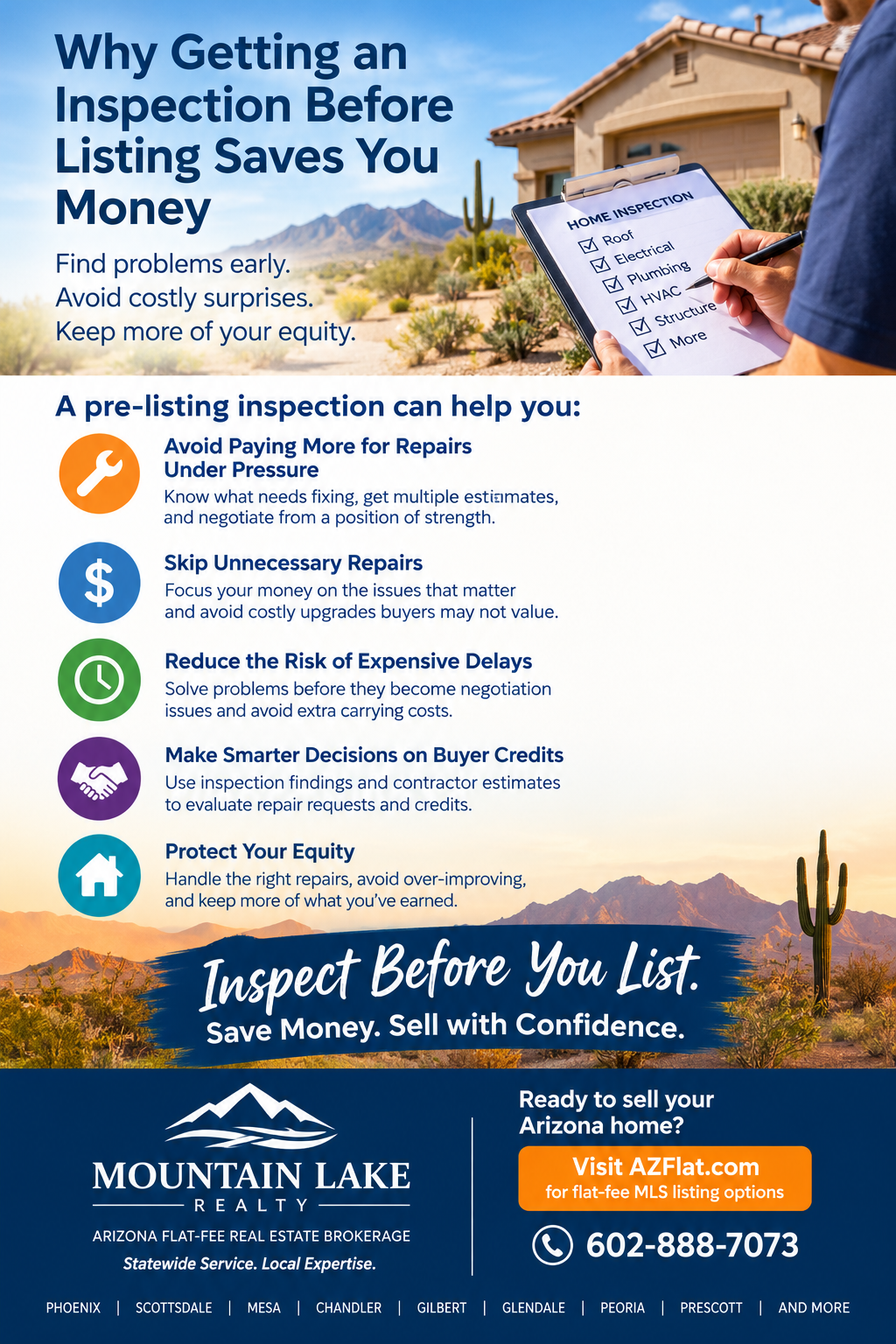
Why Getting a Home Inspection Before Listing Can Save You Money
A pre-listing home inspection helps Arizona sellers find problems early, avoid costly surprises during negotiations, and keep more of their equity at closing.
When homeowners decide to sell, they often focus on the things buyers will see first: fresh paint, clean floors, attractive landscaping, professional photography, and a competitive asking price. These are all important parts of preparing a home for the market.
But there is another step that can make a significant difference in how much money you ultimately keep from your sale: getting a professional home inspection before listing your property.
Many sellers assume the buyer will arrange an inspection after an offer is accepted. While that is a common approach, waiting until that point can leave you vulnerable to unexpected repair demands, last-minute negotiations, and even a canceled transaction.
A pre-listing inspection gives you an opportunity to identify potential problems before buyers discover them. You can decide which repairs make financial sense, prepare for questions, and approach negotiations with a better understanding of your property's condition.
For Arizona homeowners, where roof wear, air-conditioning performance, plumbing issues, and other property-specific concerns can affect a transaction, getting ahead of potential problems can be particularly valuable.
1. What Is a Pre-Listing Home Inspection?
A pre-listing inspection is a professional home inspection that a seller arranges before putting a property on the market.
It is generally similar to the inspection a buyer might order after entering into a purchase contract. The inspector evaluates accessible areas and major components of the home, including the roof, electrical systems, plumbing, heating and cooling equipment, interior features, and visible structural elements. The inspector then provides a written report describing observed conditions, potential deficiencies, and items that may require further evaluation or repair.
The purpose is not necessarily to make the home perfect. No house is perfect, and even well-maintained properties can have maintenance needs. Instead, the goal is to identify important issues early enough that you can make informed decisions before a buyer is negotiating with you.
For example, suppose you plan to list your home for $500,000. You believe it is in excellent condition, but an inspection reveals a plumbing leak, a malfunctioning air-conditioning component, and a roof issue that deserves further evaluation. Without a pre-listing inspection, these findings might emerge after you have accepted an offer. With an inspection completed beforehand, you have time to obtain estimates, evaluate the options, and decide how to address the issues.
That advance preparation can help you avoid rushed decisions when the transaction is already underway.
2. Avoid Expensive Last-Minute Repair Demands
One of the biggest financial advantages of inspecting your home before listing is the opportunity to address problems before they become negotiation issues.
Imagine a buyer submits an offer on your home. You accept the offer, the buyer completes an inspection, and the resulting report identifies several concerns. The buyer may request that you make repairs, hire licensed contractors, provide a credit, or reduce the purchase price. Depending on the contract and circumstances, the buyer may also have rights to cancel the transaction.
You now have a decision to make under pressure.
A pre-listing inspection gives you more time and flexibility. You can obtain multiple repair estimates, determine which issues are important, and decide what you are willing to fix before negotiations begin.
Consider this illustrative example:
| Expense or negotiation item | Potential cost |
|---|---|
| Roof-related repairs | $1,800 |
| Plumbing repairs | $650 |
| Air-conditioning service | $450 |
| Total estimated repairs | $2,900 |
These figures are examples only; actual costs vary by property, contractor, and the extent of the problem.
If you discover these issues before listing, you can investigate the appropriate solutions and make a plan. If the same issues surface during negotiations, the buyer may request a larger credit based on their own estimates or concerns. The seller may not have to accept every request, but having information early can improve the seller's ability to negotiate rationally rather than react under pressure.
3. Discover Problems Before They Threaten Your Sale
A real estate transaction involves several steps between accepting an offer and reaching closing. An inspection can reveal issues that affect a buyer's willingness to proceed.
Potential findings include:
- Roof damage, deteriorated roof coverings, or evidence of past leaks
- Plumbing leaks, drainage problems, or water damage
- Electrical deficiencies or unsafe visible wiring
- Air-conditioning or heating equipment that does not operate properly
- Signs of moisture intrusion or possible mold-related concerns
- Damaged windows, doors, or other building components
- Grading or drainage conditions that direct water toward the home
- Deteriorated exterior materials or visible structural concerns
The inspection does not guarantee that every defect will be found. Inspectors generally evaluate accessible and visible conditions, and some systems or areas require separate specialists. Nevertheless, identifying a significant concern early can give you time to investigate it properly.
For example, if an inspector notices evidence of roof leakage, you can consult a qualified roofing contractor to determine whether the problem involves a minor repair or a more extensive issue — much better than trying to understand the scope of a potential roof problem while a buyer is waiting for answers.
4. Why This Matters in Arizona
Arizona homes face particular maintenance considerations because of the state's climate, building styles, and long periods of intense heat. A pre-listing inspection can be especially useful for identifying concerns that may affect a buyer's confidence in the property.
Air-conditioning and cooling systems
Air-conditioning is a major consideration for many Arizona buyers. An older system is not automatically defective, but a unit that fails to operate properly can become a significant negotiation issue. A home inspector may identify operational concerns or recommend further evaluation. Knowing the condition of the equipment before listing helps you prepare for reasonable questions about its performance.
Roof condition
Arizona roofs experience prolonged sun exposure and high temperatures. Depending on the roofing material, age, installation, and maintenance history, a roof may need repairs or closer evaluation. A home inspection may identify visible concerns, but a qualified roofing contractor may be needed to determine the full extent and cost of the work. If you discover an issue before listing, you can investigate it without the added pressure of an approaching closing date.
Plumbing and water damage
Leaks beneath sinks, around fixtures, or near water heaters can sometimes go unnoticed for long periods. Even a small leak can cause damage if left unaddressed. A pre-listing inspection may identify visible evidence of leakage or deterioration, allowing you to investigate before the home is shown to prospective buyers.
Windows, doors, and exterior components
Sun exposure and ordinary wear can affect exterior materials, seals, finishes, and other components. Addressing visible maintenance issues before listing can improve presentation and help demonstrate that the property has been cared for.
The important point is not that every Arizona home has these problems. It is that understanding the actual condition of your home can help you prepare for the questions buyers are likely to ask.
5. Decide Which Repairs Are Worth Making
Finding a problem does not mean you must immediately repair everything in the inspection report. Some findings may be routine maintenance items. Others may be cosmetic concerns that have little effect on the home's marketability. Certain deficiencies may warrant immediate attention because of safety, water intrusion, or the risk of additional damage.
A practical approach is to divide the findings into three categories:
Category 1: Important repairs
These may include active leaks, significant electrical safety concerns, malfunctioning essential equipment, or other issues that require prompt professional attention. Addressing them may help reduce risk and prevent further damage.
Category 2: Repairs that could affect negotiations
These are issues a buyer might reasonably investigate or use as a basis for a repair request or credit. Whether to repair them before listing depends on the cost, market conditions, and your selling strategy.
Category 3: Cosmetic and routine maintenance
These may include minor adjustments, worn caulking, loose hardware, or other relatively inexpensive items. Some can be addressed quickly. Others may not justify the expense, depending on the home's condition and price point.
The goal is to make thoughtful decisions rather than spend money indiscriminately. A $200 repair that prevents a small leak from causing further damage may be worthwhile. A costly cosmetic upgrade that buyers are unlikely to value may not be.
Use the inspection report, qualified contractor estimates, and your pricing strategy to decide where your money will have the greatest impact.
6. Could a Pre-Listing Inspection Help You Sell Faster?
It can, although there is no guarantee that an inspection will shorten the selling process. A property can take longer to sell for many reasons, including asking price, location, competition, financing conditions, and buyer demand.
However, identifying and addressing significant property issues before listing can remove some potential obstacles from the transaction.
Consider two hypothetical sellers. Seller A lists a home without obtaining an inspection. A buyer makes an offer, the inspection identifies several concerns, and the parties spend a week or more discussing repairs and credits. The buyer becomes uncomfortable with the uncertainty, and the transaction falls apart.
Seller B arranges an inspection before listing, investigates the same concerns, and addresses selected repairs. When a buyer asks about the property's condition, the seller can provide relevant information and documentation.
Seller B has not eliminated every possible problem, but the seller may be better prepared to respond. That preparation can make the transaction more predictable and reduce the possibility of avoidable delays.
7. Build Buyer Confidence with Documentation
Buyers want to know what they are purchasing. They may be more comfortable moving forward when a seller can explain known maintenance issues and provide documentation of completed work.
Depending on the circumstances, useful documents may include:
- A copy of the pre-listing inspection report
- Receipts for completed repairs
- Contractor invoices and written estimates
- Available warranties or service records
- Air-conditioning maintenance records
- Roofing documentation, where available
- Permits or other records for work that required them
Providing documentation can help answer questions and demonstrate that identified issues were taken seriously.
However, a pre-listing inspection is not a warranty, and it does not certify that the property is free of defects. You should also understand that sharing an inspection report may bring its findings to a buyer's attention.
Before distributing the report, discuss your strategy with your real estate broker and understand your disclosure obligations. Do not conceal known material defects or assume that obtaining an inspection eliminates the duty to disclose them.
In Arizona, sellers should review the applicable disclosure requirements and provide accurate information about known material conditions. When uncertain about a particular legal obligation, consult a qualified Arizona real estate attorney.
8. Will the Buyer Still Get Their Own Inspection?
Usually, sellers should expect that buyers may arrange their own inspections even when the seller has already obtained one. A buyer's lender, insurer, or purchase contract may also involve separate inspections, evaluations, or requirements.
A pre-listing inspection does not replace the buyer's due diligence. The buyer may want an independent inspector, may have different concerns, or may request a specialist to examine a particular component.
Think of it as preparation for the selling process rather than a substitute for the buyer's inspection.
9. How Much Does a Pre-Listing Inspection Cost?
The cost depends on the home's size, location, age, features, and the inspector's pricing structure. As a broad planning estimate, a general home inspection might cost approximately $300 to $600 for many typical homes, although larger or more complex properties can cost more. This is an illustrative range, not a verified current quote for your property.
Additional evaluations — such as a specialized roof inspection, sewer scope, pest inspection, or HVAC assessment — may involve separate charges. The best approach is to request a written quote from a qualified local inspector and confirm exactly what the inspection includes.
Now consider the potential value. If an inspection costs $450 and helps you identify a $1,500 repair before it causes further damage, the inspection may prove worthwhile. If it reveals a major issue that allows you to make an informed decision about pricing and negotiations, the information may also be valuable.
The real benefit is having better information before making important financial decisions.
10. What If the Inspection Reveals a Major Problem?
This is one of the reasons some sellers hesitate to schedule an inspection. They worry that they will discover something expensive. That concern is understandable. However, not knowing about a problem does not make it disappear.
If the inspection reveals a major concern, you have several possible options:
- Determine whether the finding is confirmed or whether additional evaluation is necessary.
- Obtain estimates from appropriate licensed or qualified contractors.
- Compare the cost of repairing the problem with the potential consequences of selling the home in its current condition.
Depending on the circumstances, you might decide to complete the repair, adjust your asking price, account for the issue in negotiations, or market the property with appropriate disclosures. There is no single solution that works for every home.
11. Should You Fix Everything Before Listing?
No. In many cases, that would be an unnecessary expense. The objective is to prepare the home intelligently, not to create a property with no maintenance needs.
Before committing to expensive work, consider these questions:
- Does the issue affect safety or risk further damage?
- Is the item functioning as intended?
- Could the condition create a significant obstacle during buyer negotiations?
- What will the repair cost?
- Would the repair likely improve buyer confidence or marketability?
- Is there a less expensive, appropriate way to address the issue?
- Would an adjustment to the asking price be more practical?
A real estate professional can help you consider how the property's condition fits into the overall listing strategy. Contractors can provide technical opinions and estimates, while the inspector can explain the observations in the report.
12. A Pre-Listing Inspection Can Help You Price Your Home More Realistically
Pricing is one of the most important decisions a seller makes. An inspection does not establish market value — that requires a separate pricing analysis. However, the inspection can help you understand whether your home has maintenance or repair issues that should be considered when setting the asking price.
Suppose comparable homes have been selling for around $500,000, but your property has a known repair issue that will cost several thousand dollars to address. You can investigate the repair, determine whether to complete it, and evaluate the home's condition before deciding how to price it.
Without that information, you could list the property at a price that does not adequately account for its condition and then face difficult negotiations after receiving an offer.
The key is to combine inspection findings with a realistic market analysis rather than treating the inspection report as a pricing tool by itself. Our guide on how to price your Arizona home to sell fast covers the full pricing process.
13. The Hidden Cost of Losing a Buyer
One of the most overlooked costs in a real estate transaction is the possibility of having to start over.
When a buyer cancels after an inspection, the seller may need to relist the property, schedule new showings, and negotiate with another prospective buyer. There may also be carrying costs while the home remains unsold, including mortgage payments, property taxes, insurance, utilities, maintenance, and other expenses.
For example, suppose your total carrying costs are $3,000 per month. If an avoidable problem contributes to a one-month delay, that additional month could cost approximately $3,000. This is an illustration only — not every inspection issue causes a cancellation, and not every delayed sale can be attributed to the property's condition.
Nevertheless, the financial effect of delays can be substantial, particularly for sellers who have already purchased another home or are working toward a specific moving date.
Sell Your Arizona Home With More Confidence
A pre-listing home inspection is not a requirement, and it does not guarantee a faster sale or a higher price. But for many Arizona sellers, it provides something valuable: better information before the most important financial decisions are made.
Knowing your home's condition before listing allows you to address the right problems, price the property accurately, and approach negotiations from a position of preparation rather than surprise.
If you are considering selling your Arizona home, a pre-listing inspection is one step worth evaluating as part of your overall strategy.
To learn more about how a flat-fee MLS listing can help you keep more of your equity while still getting full MLS exposure on Zillow, Realtor.com, and other platforms, explore the available options at AZFlat.com.
Mountain Lake Realty provides Arizona flat-fee listing services statewide. Contact us at (602) 888-7073 or visit AZFlat.com to learn more.
Frequently Asked Questions About Pre-Listing Home Inspections in Arizona
Should I get a home inspection before listing my Arizona home?
A pre-listing inspection is not required, but it can help you identify repair issues before buyers discover them, prepare for negotiations, and make more informed pricing decisions. Many Arizona sellers find the advance information valuable.
How much does a pre-listing home inspection cost in Arizona?
A general home inspection typically costs approximately $300 to $600 for many homes, though larger or more complex properties may cost more. Specialized inspections — such as roof, HVAC, or sewer evaluations — may involve additional charges. Request a written quote from a qualified local inspector.
Do I have to disclose the inspection report to buyers?
Arizona sellers have disclosure obligations regarding known material defects. Obtaining an inspection and then concealing its findings could create legal exposure. Discuss your disclosure strategy with your real estate broker and, if needed, a qualified Arizona real estate attorney.
Will the buyer still get their own inspection if I already had one?
Yes, most buyers will still arrange their own inspection. A pre-listing inspection is preparation for the seller, not a substitute for the buyer's due diligence.
What if the inspection finds a major problem?
Obtain contractor estimates to understand the actual scope and cost. Then evaluate your options: repair the issue, adjust your asking price, or disclose the condition and negotiate accordingly. Having that information before listing gives you more time and flexibility than discovering it mid-transaction.
Dash List by Mountain Lake Realty
Dash List by Mountain Lake Realty is Arizona's flat fee MLS listing service — list your home on the MLS starting at $59 upfront and 0.5% at closing. Full MLS exposure, Zillow Showcase, professional photos, and contract support included. Serving Phoenix, Scottsdale, Tucson, Mesa, Chandler, Gilbert, and all of Arizona.
Explore Topics
Written by
Thomas Mastromatto
Content creator and writer sharing insights and stories.