
Why Is My House Not Selling in Arizona? 9 Reasons Your Home Isn\'t Getting Offers
Is your Arizona home not selling? Discover 9 common reasons homes fail to attract offers, plus practical ways to improve pricing, marketing, and buyer interest.
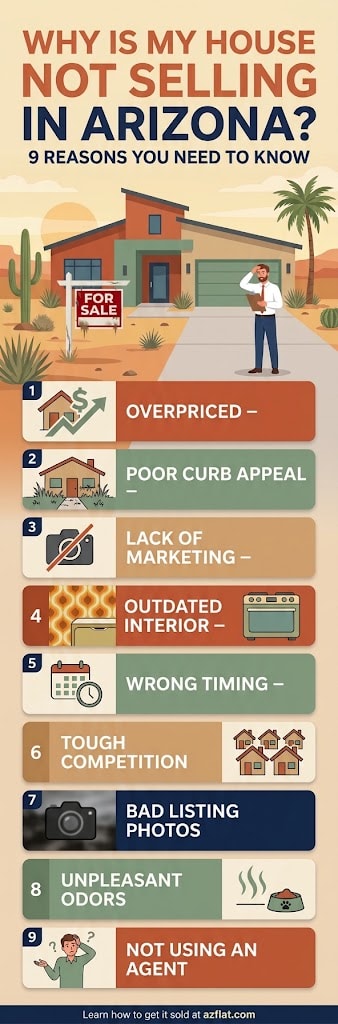
Selling a home in Arizona can be frustrating when your property is listed on the MLS, appears on Zillow, and still isn't attracting serious buyers. You may have invested time preparing your home, taken professional photographs, and worked with a real estate agent, yet showings and offers remain disappointing.
The good news is that a home that isn't selling is not necessarily a home that cannot sell. In many cases, the problem can be identified and addressed by examining the asking price, online presentation, property condition, showing availability, competition, and overall marketing strategy.
Arizona's housing market is not one uniform market. Conditions in Phoenix, Scottsdale, Mesa, Gilbert, Chandler, Glendale, Peoria, Prescott, and other communities can differ significantly. Even two homes in the same neighborhood may attract different levels of buyer interest because of their condition, price, location, and features.
If your Arizona home has been sitting on the market without an acceptable offer, here are nine reasons it may not be selling — and practical steps you can take to improve your results.
1. Your Asking Price Is Too High for the Current Market
One of the most common reasons a home fails to attract offers is an asking price that exceeds what buyers believe the property is worth.
Sellers naturally want to receive the highest possible price. You may have invested thousands of dollars in improvements, remember what a neighbor received several years ago, or believe your property should command a premium because of its location.
However, buyers compare your home with other properties currently available and recently sold homes that offer similar features. If comparable properties provide better value, buyers may skip your listing entirely.
How to determine whether your price is the problem
Review three categories of properties:
- Recently sold homes: These help establish what buyers have actually paid for comparable properties.
- Active listings: These show the alternatives buyers can consider today.
- Pending listings: Where reliable information is available, these may provide clues about properties attracting offers, although final contract prices may not be publicly available before closing.
Compare square footage, bedroom and bathroom counts, lot size, age, condition, location, upgrades, and other meaningful differences. A home with an updated kitchen, newer roof, and attractive outdoor living space may justify a different price than a similar property requiring substantial repairs.
Your original asking price should be based on current market evidence, not simply on what you hope to receive.
What to do: Ask for an updated comparative market analysis. If your property has received online views but few inquiries or showings, pricing may be discouraging buyers before they ever visit. Our guide on how to price your Arizona home to sell fast walks through the process in detail.
2. Your Listing Photographs Are Not Making a Strong First Impression
Most buyers begin their home search online. Your photographs may determine whether they schedule a showing or move on to another property.
Dark rooms, cluttered countertops, poorly framed photographs, and unappealing exterior images can make an otherwise desirable home look less attractive.
Arizona homes often compete on features such as natural light, open floor plans, covered patios, pools, mountain views, and outdoor entertaining areas. If your listing photographs fail to showcase these features, buyers may not recognize the property's full appeal.
Common photography mistakes
- Using dark or blurry photographs
- Showing rooms filled with unnecessary furniture or personal belongings
- Failing to photograph important upgrades
- Neglecting the backyard, patio, pool, or outdoor living area
- Using exterior photographs that do not present the home at its best
- Uploading too few photographs to explain the property's layout and features
Professional real estate photography can help present your property more effectively. Before photographs are taken, clean the home, open window coverings where appropriate, remove unnecessary items, and prepare each room.
If the home has a pool, guest house, workshop, mountain view, or upgraded outdoor kitchen, make sure those features are clearly represented.
What to do: Review your listing as if you were a buyer seeing it for the first time. Would the photographs make you want to schedule a showing?
3. Your Home Is Not Standing Out From Competing Listings
Even a well-priced home can struggle if buyers see several comparable properties that appear more attractive.
Imagine a buyer searching for a three-bedroom home in Mesa or Chandler. The buyer finds multiple properties within the same price range. One has professional photographs, a clean presentation, a desirable backyard, and a convenient showing schedule. Another has dark photographs and limited information. Both properties might be priced similarly, but the first may generate more interest.
Your competition is not limited to homes that have already sold. It includes every comparable property a buyer can choose instead.
Evaluate your listing against the competition
Look at competing listings on the MLS, Zillow, and other real estate websites. Consider:
- Which properties have better photographs?
- Which homes offer more usable space or desirable features?
- Are comparable properties offering seller concessions?
- Have competing sellers reduced their prices?
- Does your listing clearly explain its strongest selling points?
- Are buyers able to schedule a showing conveniently?
You do not necessarily need to spend thousands of dollars renovating your home to compete. Sometimes decluttering, improving curb appeal, correcting obvious maintenance problems, or adjusting the asking price can make a meaningful difference.
What to do: Reassess your property from the buyer's perspective. Identify the two or three areas where competing homes appear to offer better value, then determine which improvements are financially worthwhile.
4. Your Online Listing Description Is Too Generic
Your photographs may attract a buyer's attention, but your listing description should help turn that attention into a showing.
Descriptions such as "beautiful home in a great neighborhood" or "must see" do little to distinguish one property from another. Buyers want specific information that helps them understand the home's advantages.
For an Arizona property, meaningful selling points might include a shaded patio, low-maintenance landscaping, a recently updated HVAC system, a split-bedroom floor plan, a home office, or convenient access to shopping and transportation.
Write a description that answers buyers' questions
Explain what makes the property appealing and how its features may benefit a prospective owner. For example, rather than merely saying that a property has a backyard, describe its covered patio and space for outdoor dining if those features are present.
If the property has recent improvements, identify them accurately. If the home has a functional floor plan, explain its layout rather than relying on vague adjectives. Avoid unsupported claims about investment returns, future appreciation, or neighborhood characteristics.
What to do: Rewrite your listing description to emphasize the property's strongest verifiable features. Keep the language clear, informative, and easy to scan.
5. Buyers Have Difficulty Scheduling Showings
A property cannot attract an offer from a buyer who cannot conveniently see it.
Showing restrictions can become a hidden obstacle. If buyers must provide excessive advance notice, wait for narrow appointment windows, or work around inconvenient access arrangements, some may choose another property. This can be especially important when buyers are comparing several homes during a single afternoon.
In a competitive market, a buyer who cannot see your home today may make an offer on a different property tomorrow.
What to do: Review your showing instructions and access arrangements. Make it as easy as possible for qualified buyers to schedule and complete a showing. A lockbox, flexible scheduling, and prompt confirmation can all help.
6. The Property Has Condition or Maintenance Issues
Buyers in Arizona are generally aware that homes require ongoing maintenance. However, visible deferred maintenance can raise concerns about what else may need attention.
Cracked stucco, damaged roof tiles, worn flooring, outdated fixtures, non-functional appliances, and obvious water stains can all affect buyer confidence and willingness to pay the asking price.
Some buyers will negotiate a lower price to account for needed repairs. Others may simply move on to a property in better condition.
What to do: Walk through the property as a buyer would. Address obvious maintenance issues before listing, or price the home to reflect its current condition accurately. Disclose known material defects as required by Arizona law.
7. The Home Is Difficult to Show or Presents Poorly in Person
A home that photographs well but disappoints buyers during showings can struggle to generate offers.
Factors that can affect the in-person experience include strong odors from pets, smoke, or cooking; excessive clutter or personal belongings; poor lighting; uncomfortable temperatures; and a layout that does not flow well.
Arizona buyers often expect clean, well-maintained homes that feel move-in ready. A property that requires significant imagination to visualize as a comfortable living space may receive fewer offers.
What to do: Prepare the home for showings as thoroughly as you would for professional photographs. Address odors, improve lighting, reduce clutter, and maintain a comfortable temperature. Consider a pre-listing walkthrough with an objective third party who can identify issues you may have stopped noticing.
8. You Are Not Receiving or Acting on Buyer Feedback
Buyer feedback after showings can provide useful information about how the property is being perceived.
If multiple buyers mention the same concern — the price, a specific condition issue, the layout, or the neighborhood — that pattern may indicate a problem worth addressing.
Feedback is not always available or reliable. Some buyers do not share their true reasons for passing on a property. However, when consistent themes emerge, they deserve attention.
What to do: Request specific feedback after showings whenever it is available. Use that information alongside comparable sales, competing listings, and actual buyer activity to decide what to change.
9. Your Marketing Strategy Is Not Reaching Buyers Effectively
Listing a property in the Multiple Listing Service (MLS) can provide broad exposure through participating real estate websites and other distribution channels. However, publication alone does not guarantee that buyers will notice the listing or consider it worth viewing.
Effective marketing combines accurate property information, attractive presentation, competitive pricing, and a strategy for reaching prospective buyers.
Understand what online exposure can and cannot do
Your property may appear on Zillow and other websites, but the quality and presentation of that exposure still matter. Buyers need to recognize the property's appeal, understand its price relative to alternatives, and have a convenient way to arrange a showing.
Additional marketing options may include professional photography, floor plans, virtual tours, enhanced listing presentation, and available premium listing products. For example, Zillow Showcase offers enhanced listing presentation and other features for eligible listings through participating professionals.
No marketing service can guarantee a sale, and increased exposure does not automatically overcome an unrealistic asking price.
What to do: Ask your listing professional to explain where your property is being marketed, how its presentation compares with competing homes, and what measurable results the current strategy is producing.
Should You Lower Your Asking Price?
A price reduction may be appropriate when market evidence indicates that your asking price is limiting buyer interest. However, a reduction should be part of a considered strategy rather than an automatic response to a certain number of days on market.
Before changing the price, review comparable sales, active competition, buyer feedback, and the level of interest your listing has received. Consider the size of the adjustment as well as the resulting price. A very small reduction may not materially change how buyers compare your property with competing homes. A more substantial adjustment may position the property differently within relevant search ranges.
Also consider whether the property has presentation or access problems that should be addressed at the same time. Our guide on whether to reduce your price or wait covers this decision in detail.
The objective is not simply to reduce the asking price. It is to establish a competitive position that gives qualified buyers a compelling reason to consider your home.
How to Calculate Your Potential Net Proceeds
Your net proceeds are not the same as your sale price. Depending on your circumstances, expenses may include mortgage payoff, listing-side compensation, any buyer-agent compensation you agree to pay, escrow and title charges, negotiated concessions, repairs, HOA-related charges, and other transaction costs.
Real estate compensation is negotiable. Sellers should evaluate the specific services, fees, and obligations in their listing agreement rather than assume that every brokerage charges the same amount. There is always a listing commission — the question is how much you pay and what services it includes.
For illustration, consider a home selling for $500,000. A traditional 3% listing commission would cost $15,000. With a flat-fee listing through AZFlat.com, the listing-side compensation is $2,500 — equal to 0.5% of the sale price. That difference is $12,500 in potential savings on the listing side alone. This is an arithmetic example; other transaction expenses apply, and your actual net proceeds will depend on the full terms of your sale.
Comparing written service proposals and estimating all expected expenses can help you make a better-informed decision.
Should You Change Realtors if Your Arizona Home Isn't Selling?
If your home is not attracting offers, it may be time for an honest review of your current listing arrangement.
Start by asking your agent for an explanation of the property's performance, an updated market analysis, and a specific plan for addressing the problems identified. A lack of offers does not automatically mean your agent has done something wrong. Market conditions, property characteristics, pricing, and buyer preferences all influence results.
However, you should understand what services your listing agreement includes, what marketing has been performed, how showing requests are handled, and what changes your agent recommends.
If you are considering changing brokerages, carefully review the duration and termination provisions of your existing listing agreement before taking action.
Arizona sellers have different service needs. Some want comprehensive representation and hands-on assistance throughout the transaction. Others prefer a lower-cost listing arrangement while managing some aspects of the sale themselves. Our Arizona flat-fee MLS guide explains how a flat-fee listing arrangement works and what to compare when evaluating your options.
Sell Your Arizona Home With a Clear Strategy
When a home isn't selling, the answer is rarely to make random changes and hope for a better result.
Start with the evidence. Examine the price, compare competing properties, review your photographs, evaluate showing activity, and listen for recurring buyer concerns. Then prioritize the changes most likely to improve the property's position in the market.
For Arizona homeowners, a successful selling strategy should account for local market conditions rather than rely on statewide generalizations. A property in Phoenix may face different competition from one in Prescott, Tucson, or a smaller Arizona community.
The goal is to make your home an attractive and appropriately priced option for the buyers most likely to purchase it.
Explore Flat-Fee Listing Options With AZFlat.com
Mountain Lake Realty provides Arizona-focused flat-fee real estate listing options for homeowners who want to understand their choices when selling.
A flat-fee listing arrangement may offer an alternative to percentage-based listing compensation, depending on the package and services selected. Sellers should compare the actual services included, any additional charges, marketing options, and contractual obligations before making a decision.
Learn more about Arizona flat-fee MLS listing options and explore the available services to determine which approach best fits your selling goals.
Ready to sell your Arizona home? Begin with a realistic pricing strategy, an effective listing presentation, and a clear understanding of the costs and services involved.
Frequently Asked Questions About Homes That Won't Sell in Arizona
Why is my house not selling in Arizona?
Common reasons include an asking price that exceeds buyer expectations, weak photographs, competition from better-presented homes, limited showing availability, property-condition concerns, and ineffective marketing. Reviewing buyer feedback and comparable properties can help identify the most likely cause.
How long should I wait before lowering my asking price?
There is no universal number of days. Review your listing's performance, local comparable sales, competing properties, and buyer feedback. If the evidence indicates that the asking price is limiting interest, consider an adjustment rather than waiting indefinitely.
Does listing a home on Zillow guarantee that it will sell?
No. Online exposure can help buyers discover a property, but it does not guarantee showings or offers. Price, condition, photographs, competition, and the overall buying experience remain important.
Should I renovate my Arizona home before selling?
Not necessarily. Addressing obvious maintenance issues and improving presentation often provide better returns than major renovations. The right answer depends on the property's current condition, the local market, and the cost of the improvements relative to the likely benefit.
What is a flat-fee MLS listing in Arizona?
A flat-fee MLS listing allows a seller to pay a fixed fee for MLS access and syndication to Zillow, Realtor.com, and other platforms, rather than a percentage-based commission. The seller typically handles some aspects of the transaction directly. Services, fees, and obligations vary by provider, so comparing written proposals is important.
Dash List by Mountain Lake Realty
Dash List by Mountain Lake Realty is Arizona's flat fee MLS listing service — list your home on the MLS starting at $59 upfront and 0.5% at closing. Full MLS exposure, Zillow Showcase, professional photos, and contract support included. Serving Phoenix, Scottsdale, Tucson, Mesa, Chandler, Gilbert, and all of Arizona.
Explore Topics
Written by
Thomas Mastromatto
Content creator and writer sharing insights and stories.