Maricopa County Housing Market Report: October 2026
Explore the October 2026 Maricopa County housing market report — home prices, inventory, buyer demand, seller strategies, and Arizona flat-fee MLS options for Phoenix, Mesa, Scottsdale, and beyond.

The Maricopa County housing market continues to present important decisions for Arizona homeowners, buyers, and real estate investors. Home prices, available inventory, mortgage affordability, days on market, and buyer negotiating power all influence how a property performs when it goes up for sale.
For homeowners considering selling in Phoenix, Mesa, Chandler, Gilbert, Glendale, Peoria, Scottsdale, Surprise, or other Maricopa County communities, understanding current housing conditions is an essential first step. The market is not identical in every city or price range, and a strategy that works in one neighborhood may not work in another.
This October 2026 Maricopa County housing market report examines recent housing data, pricing trends, competition among sellers, buyer behavior, and practical steps homeowners can take to prepare for a successful sale. It also explains why professional photography, realistic pricing, effective marketing, and a careful review of real estate listing costs matter in a market where buyers have more homes to compare.
Maricopa County Housing Market at a Glance
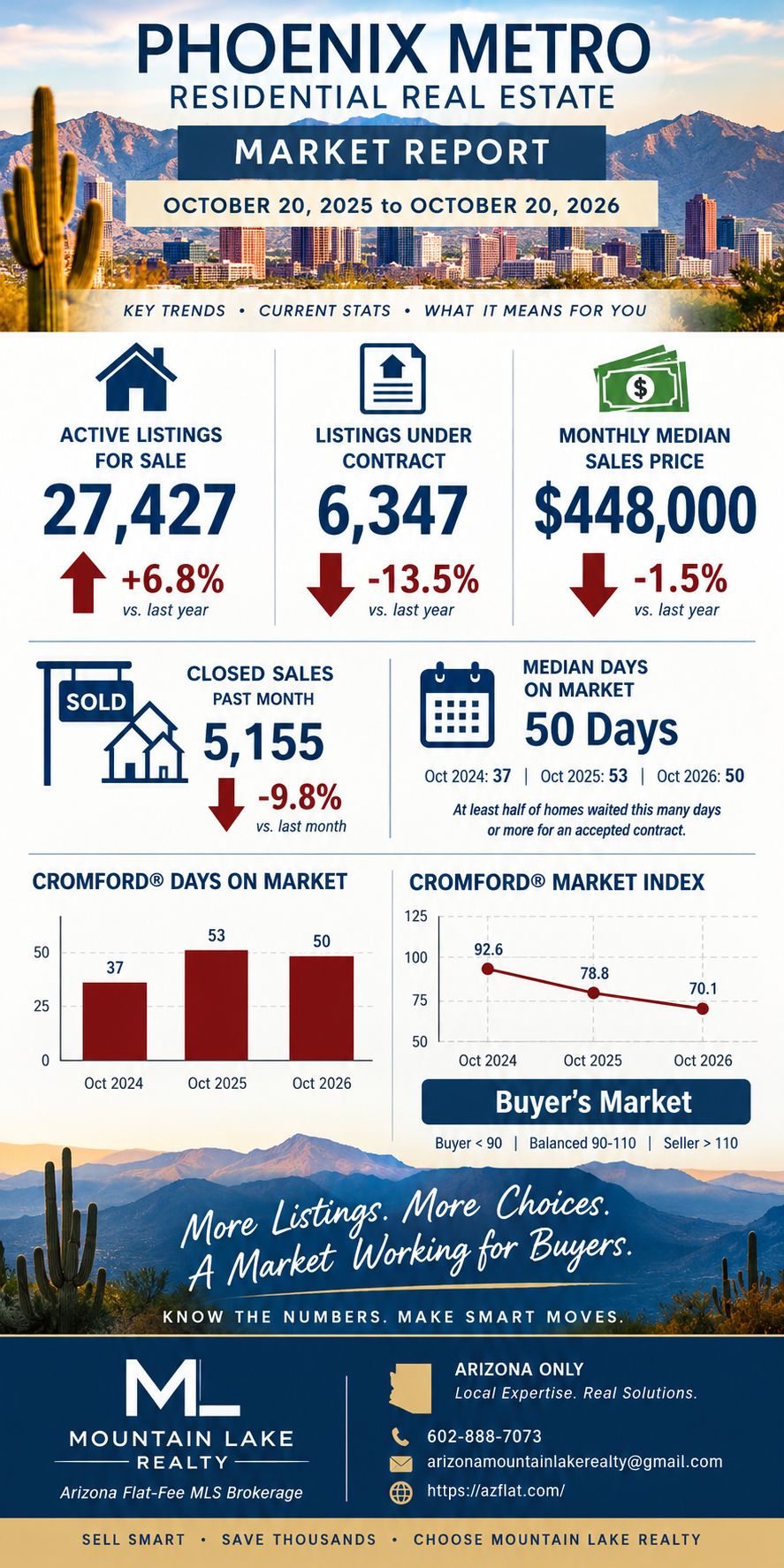
Recent September 2026 reporting from Phoenix REALTORS® indicates that the county's median home sale price was approximately $500,000, down about 2% from the same period a year earlier. The county also had approximately 15,422 homes for sale and 3.9 months of housing supply. Pending sales declined substantially year over year, highlighting the importance of watching buyer demand as well as prices.
These figures suggest a market in which sellers cannot automatically assume that a home will sell quickly or receive multiple offers. Buyers remain active, but affordability and competition influence their decisions.
Key indicators to watch:
- Home prices: Median sale prices help homeowners understand broad market direction, although individual properties can perform differently.
- Housing inventory: More available homes give buyers additional choices and make presentation and pricing more important.
- Pending sales: Properties going under contract provide an indication of near-term buyer activity.
- Days on market: The time required to secure a buyer can affect sellers' moving plans and carrying costs.
- Negotiations: Offers may include price adjustments, closing-cost concessions, repairs, or other negotiated terms.
Housing statistics change monthly. Homeowners should review the latest local data before setting a listing price or making a major financial decision.
1. What Is Happening to Home Prices in Maricopa County?
Home prices remain one of the most closely watched indicators in the Arizona real estate market. For many homeowners, their property's value represents a substantial portion of their net worth. For buyers, the purchase price affects the down payment, mortgage balance, monthly payment, and long-term affordability.
Recent reporting places the countywide median sale price for single-family homes near $500,000, with a decline of approximately 2% compared with the previous year.
A change in the median does not mean every home has lost the same percentage of its value. The median reflects the midpoint of completed sales, and the types of properties sold during a month can influence the result. An increase in sales of smaller homes may lower the median even if comparable homes in a particular neighborhood have maintained their values. Similarly, a greater number of luxury transactions may raise the median without indicating equivalent appreciation across the entire market.
Why Local Comparable Sales Matter
Homeowners preparing to sell should focus on recent closed sales of similar properties in their immediate area. Useful comparisons include:
- Similar square footage and floor plans
- Comparable bedroom and bathroom counts
- Similar lot sizes and property types
- Similar age, condition, and renovation quality
- Comparable neighborhoods and school boundaries
- Recent sale dates and actual negotiated prices
Active listings are also important, but they answer a different question. They show what competing sellers are asking — not necessarily what buyers are willing to pay. A home listed at $550,000 is not proof that another similar property is worth $550,000. A more reliable pricing strategy considers closed sales, pending transactions, active competition, and the condition of the property being evaluated.
2. Housing Inventory and Competition Among Sellers
Inventory is a critical factor in determining how much competition a homeowner faces when listing a property. Recent county reporting indicated approximately 15,422 homes for sale and about 3.9 months of supply. Months of supply estimates how long the available inventory would take to sell at the prevailing sales pace if no additional homes entered the market.
Inventory levels can vary substantially by community, property type, and price range. A neighborhood with limited listings may offer a very different selling environment from a price bracket with numerous similar homes competing for the same buyers.
What Additional Inventory Means for Sellers
When buyers have several comparable homes to consider, they can be more selective. They may compare price, photographs, condition, location, energy efficiency, landscaping, and expected repair costs before deciding which homes deserve a showing.
This creates a practical challenge for sellers: a property must offer a compelling combination of price, condition, and presentation. Homeowners should evaluate their competition before listing and continue monitoring it while the property is on the market.
Important questions to ask:
- How many similar homes are currently available?
- How long have competing properties been listed?
- Have competing sellers reduced their asking prices?
- Are new listings entering the market regularly?
- Which properties have gone under contract?
- What advantages does your property offer?
A listing strategy should respond to the actual competition rather than relying solely on broad countywide statistics.
3. Are Maricopa County Homes Taking Longer to Sell?
Time on market is another essential measure of housing conditions. A home that sells within a few weeks produces a different financial and logistical outcome from one that requires several months to attract an acceptable offer.
Recent reports show that marketing times vary by data source, property category, and location. Some reports track median days for active listings, while others measure days on market for properties that have already sold. These figures should not be treated as interchangeable.
The Real Cost of Waiting
A longer selling period can create expenses that homeowners often underestimate:
- Mortgage payments and interest
- Property taxes and insurance
- Utilities and maintenance
- Pool service and landscaping
- Homeowners association assessments
- Repairs or improvements needed to remain competitive
- Temporary housing, storage, or moving expenses
Consider a homeowner whose combined carrying costs total $3,000 per month. An additional three months on the market would represent $9,000 in carrying costs — before accounting for repairs, concessions, or other expenses. The lesson: the highest asking price is not necessarily the most profitable strategy. Sellers should consider the likely net proceeds and the time required to achieve them.
4. Pricing a Home Correctly in the October 2026 Market
Pricing is one of the most important decisions a seller makes. An asking price influences how many buyers consider the property, how it compares with competing listings, and whether prospective buyers schedule a showing.
An overpriced home may receive limited interest during the early weeks of its listing. If the property remains available while competing homes sell, buyers may begin to question its value or condition. A price reduction can help correct the problem, but it may also mean losing valuable time and negotiating leverage.
A Practical Pricing Strategy
Start with comparable sales. Review recent transactions involving similar properties in the same neighborhood or competitive area.
Study active listings. Buyers will compare the home with properties they can purchase right now.
Consider pending transactions. Although final sale prices may not yet be public, pending activity can help indicate which properties are attracting offers.
Account for condition. Updated kitchens, bathrooms, flooring, roofs, HVAC systems, and other major features can influence buyer perceptions and offer prices.
Evaluate the competition honestly. Understand what makes your property more attractive — or less attractive — than nearby alternatives.
Monitor the first weeks. Showing activity, online engagement, and buyer feedback can help determine whether the original strategy is working.
Pricing should not be based exclusively on what a homeowner paid for the property, how much was spent on improvements, or how much equity the owner hopes to receive. The market ultimately determines what buyers are willing to offer.
5. Why Professional Real Estate Photography Matters
Online presentation is a major part of selling a home in today's Maricopa County real estate market. Buyers often review listing photographs before deciding whether to schedule an in-person showing.
Poor photographs can make rooms appear dark, cramped, cluttered, or less appealing than they are in reality. Strong photography helps communicate room dimensions, natural light, layout, finishes, and the property's overall condition. Professional real estate photography can help a listing make a better first impression — especially when buyers are comparing several similar properties.
Preparing a Home for Photographs
Before the photographer arrives, homeowners should:
- Remove unnecessary items from countertops and tables
- Open blinds and curtains where appropriate
- Turn on suitable interior lighting
- Clean windows, mirrors, and glass surfaces
- Remove vehicles from the driveway when practical
- Tidy landscaping and outdoor living spaces
- Make beds and organize bedrooms
- Remove personal items that distract from the home's features
Photography is not a substitute for correct pricing, but it can significantly improve the way a property is presented to potential buyers. For properties with attractive outdoor areas, pools, views, or distinctive architectural features, well-planned photography can communicate those advantages to buyers browsing online.
6. What Maricopa County Buyers Are Looking For
Buyers in the Phoenix metropolitan area must weigh purchase prices against mortgage rates, taxes, insurance, maintenance, and other ownership costs. A home that appears affordable based on its asking price may still exceed a buyer's monthly budget once financing and operating expenses are included.
Buyers may also compare resale homes with newly constructed properties. Builder incentives, interest-rate buydowns, appliance packages, and closing-cost assistance can influence the total value of a new home. Resale sellers should understand this competition and consider whether their property offers advantages such as an established neighborhood, mature landscaping, completed upgrades, a larger lot, or convenient access to employment and amenities.
Seller Concessions and Negotiations
In some transactions, a seller may agree to contribute toward a buyer's eligible closing costs or other permitted expenses. Such concessions can help address affordability concerns, subject to the purchase contract, lender requirements, and applicable limits.
A concession should be evaluated as part of the complete offer rather than in isolation. An offer with a slightly higher price and a reasonable closing-cost concession may produce a different net result from an offer with a lower price and no concession. Sellers should compare financing terms, contingencies, requested repairs, closing dates, and the likelihood of the transaction closing — not simply the headline offer price.
7. Community Insights: Phoenix, Mesa, Scottsdale, and Beyond
Maricopa County contains a diverse collection of housing markets. Countywide statistics are useful for identifying broad trends, but they cannot replace local analysis.
Phoenix
Phoenix includes a wide range of property types, neighborhoods, and price points. Location, property condition, lot characteristics, and nearby amenities can significantly influence value. Sellers in Phoenix benefit from flat-fee MLS listing services that provide full MLS exposure without a traditional percentage-based commission.
Mesa
Mesa's housing market includes established neighborhoods, newer developments, townhomes, and single-family residences. Buyers may place different values on commuting convenience, home size, and the age of major systems. Mesa sellers can explore flat-fee MLS options in Mesa to maximize their net proceeds.
Scottsdale
Scottsdale contains several distinct price segments, including luxury homes, condominiums, townhomes, and more moderately priced properties. Countywide medians are especially unlikely to describe the full range of this city's housing market. Scottsdale flat-fee MLS listings are available for sellers who want professional MLS exposure at a fraction of traditional commission costs.
Chandler and Gilbert
Chandler and Gilbert attract buyers evaluating employment access, neighborhood amenities, schools, and housing condition. Sellers in these East Valley communities should compare properties with similar layouts, age, lot size, and community features rather than relying on a single citywide estimate.
Glendale, Peoria, Surprise, and the West Valley
West Valley markets may differ from central Phoenix and the East Valley in new-home competition, commuting patterns, lot characteristics, and the mix of available properties. The most useful housing report for a specific seller combines countywide context with a detailed analysis of the immediate neighborhood.
8. What Sellers Should Do Before Listing a Home
Preparation can reduce avoidable problems and help a property compete more effectively in the current Maricopa County real estate market.
Review the property's likely market value. Obtain a comparative market analysis based on recent, relevant sales. Ask how the recommended asking price compares with active competition and recently sold homes.
Address visible maintenance issues. Small defects can influence buyer perceptions. Repair leaking faucets, damaged trim, loose handles, burned-out lights, and other obvious problems when practical.
Organize important property information. Gather information about renovations, permits where applicable, warranties, service records, HOA requirements, and known property issues. Accurate disclosures are an important part of an Arizona real estate transaction.
Establish a marketing plan. Determine how the home will be photographed, described, entered into the MLS, and presented on participating real estate websites.
Understand the expected net proceeds. Estimate the sale price and subtract mortgage payoffs, negotiated compensation, closing expenses, concessions, repair costs, and other applicable charges. A net sheet can help sellers compare different strategies before making a decision.
Make a plan for reviewing offers. Decide which terms matter most, including price, financing, contingencies, closing date, and the buyer's ability to complete the transaction.
9. Understanding the Cost of Selling a Home in Arizona
The cost of selling real estate can vary depending on the services selected, the transaction terms, and the property itself. Homeowners should distinguish among listing-service fees, negotiated real estate compensation, title and escrow expenses, concessions, repairs, mortgage payoffs, and other transaction costs.
Real estate compensation is negotiable. Sellers should understand exactly what a brokerage's fee covers and what additional services or expenses may apply. For a detailed breakdown, see our guide to understanding the cost of selling a home in Arizona.
Comparing Traditional and Flat-Fee MLS Options
A traditional percentage-based listing arrangement and an Arizona flat-fee MLS service may use different fee structures. Neither should be evaluated on price alone. A homeowner comparing options should ask:
- What is the upfront listing fee?
- Is there a separate fee at closing?
- What services are included?
- Are professional photographs included or optional?
- Is a lockbox provided?
- Who manages listing changes and price updates?
- What assistance is available with forms and disclosures?
- How are buyer inquiries and showing requests handled?
- What other expenses should the seller expect?
A flat-fee MLS arrangement may appeal to homeowners who want to manage more of the selling process themselves while obtaining full MLS exposure through a licensed brokerage. However, a lower listing fee does not automatically mean a lower total transaction cost. Sellers should compare the complete written fee schedule and determine which responsibilities they are prepared to handle.
Mountain Lake Realty and Arizona Flat-Fee MLS Services
Mountain Lake Realty provides Arizona-focused flat-fee real estate listing options for homeowners evaluating alternatives to percentage-based listing fees. Our packages start at $59 and include MLS entry, syndication to Zillow, Realtor.com, and Homes.com, and the tools sellers need to compete in today's market.
For sellers who are comfortable taking an active role in the sale, a flat-fee approach may offer a way to manage the upfront cost of MLS exposure while retaining control over important decisions such as pricing, property preparation, and negotiations. Before selecting a service, homeowners should review the current package terms, included services, any closing fees, and the scope of brokerage assistance.
10. Should You Sell Your Maricopa County Home Now or Wait?
There is no universal answer. The right time to sell depends on personal circumstances, the property's market position, available housing alternatives, and the cost of holding the property.
Rather than trying to predict the exact bottom or top of the market, sellers should consider several practical questions:
What are comparable homes selling for? Recent closed transactions offer a stronger starting point than online estimates alone.
How much competition exists? A large number of similar listings may require a more competitive price or stronger presentation.
What will it cost to wait? Calculate ongoing ownership expenses and any additional costs associated with delaying the move.
How much equity is available? Estimate net proceeds after the mortgage payoff and transaction expenses.
Where will you go next? Selling and buying in the same market can involve trade-offs. A lower sale price may coincide with an opportunity to purchase another property at a more favorable price.
Is the home ready? Repairs, cleaning, photography, and documentation can take time, and rushing them may create unnecessary complications.
A realistic plan based on the homeowner's financial situation is generally more useful than making a decision based on headlines alone.
11. Monitor the Market After Listing
A housing market report is not only useful before a property goes on the market. Sellers should continue tracking conditions throughout the listing period.
New competing properties may enter the market. Similar homes may reduce their asking prices. Pending listings may close at prices that influence the perceived value of your property. If showing activity is weak, examine the evidence rather than automatically assuming that more time will solve the problem.
Possible factors include asking price, photographs, property condition, access for showings, listing accuracy, and competition. If a price adjustment is necessary, it should be based on current evidence and a clear understanding of the property's position in the market. Regular reviews can help sellers respond to changing conditions rather than allowing a listing to become stale.
Conclusion: Maricopa County Sellers Need a Strategy Built on Current Data
The October 2026 Maricopa County housing market reflects a real estate environment in which pricing, affordability, inventory, and buyer activity all deserve close attention. Recent reporting points to a median single-family sale price near $500,000, increased inventory compared with the previous year, and weaker pending-sale activity.
These trends do not mean every home will struggle to sell — but they reinforce the importance of evaluating each property individually. Homeowners can improve their decision-making by reviewing comparable sales, studying competing listings, preparing the property carefully, and understanding the full cost of the transaction before committing to a strategy.
Ready to list your Maricopa County home? Dash List flat-fee MLS packages start at $59 — full MLS exposure, professional presentation, and a licensed Arizona broker in your corner. Get listed today and keep more of your equity.
Dash List by Mountain Lake Realty
Dash List by Mountain Lake Realty is Arizona's flat fee MLS listing service — list your home on the MLS starting at $59 upfront and 0.5% at closing. Full MLS exposure, Zillow Showcase, professional photos, and contract support included. Serving Phoenix, Scottsdale, Tucson, Mesa, Chandler, Gilbert, and all of Arizona.
Explore Topics
Written by
Thomas Mastromatto, Mountain Lake Realty
Content creator and writer sharing insights and stories.