Phoenix Metro Housing Market Report – October 2026: More Homes for Sale, Fewer Buyers Under Contract
Explore the October 2026 Phoenix Metro housing market report, including 27,427 active listings, a $448,000 median sales price, 50 days on market, and what buyers and sellers should know.
The Phoenix Metro housing market is showing signs of a more challenging environment for home sellers. According to the October 2026 Cromford Report statistics, active listings have increased, the number of homes under contract has declined, and the monthly median sales price has slipped compared with a year ago.
For buyers, these conditions may create more opportunities to compare properties, negotiate terms, and take time to evaluate a home before making an offer. For sellers, the message is equally important: pricing, presentation, marketing, and a realistic understanding of current competition can make a significant difference.
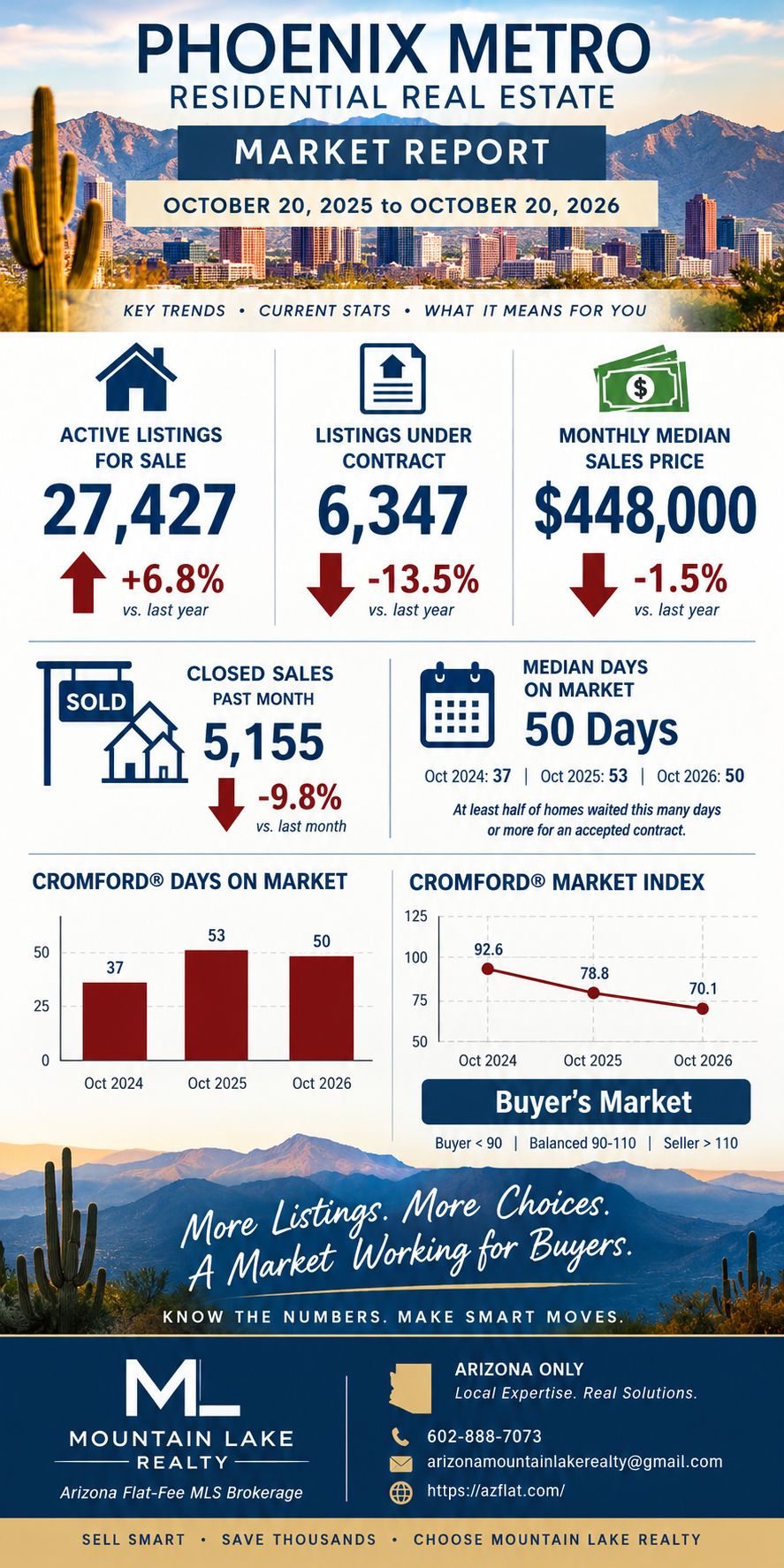
The October report covers the period from October 20, 2025, to October 20, 2026, and provides a snapshot of residential real estate activity across areas covered by the Arizona Regional Multiple Listing Service.
Here are the most important numbers:
- 27,427 active listings — Up 6.8% year over year
- 6,347 listings under contract — Down 13.5%
- $448,000 monthly median sales price — Down 1.5%
- 5,155 closed sales — Down 9.8% for the past month
- 50 median days on market — Compared with 53 days in October 2025 and 37 days in October 2024
- 70.1 Cromford Market Index — Indicating buyer-favorable conditions
Taken together, these indicators suggest that Phoenix-area sellers need to pay close attention to competition and buyer demand rather than relying on the market conditions of previous years.
1. Active Listings Increase to 27,427
The Phoenix Metro area recorded 27,427 active listings for sale in the October 2026 report, an increase of 6.8% from the same period a year earlier.
More available homes give buyers additional choices. When shoppers can compare multiple properties in similar neighborhoods and price ranges, sellers must provide compelling reasons for buyers to choose their homes.
Competition can be particularly important when several similar properties are listed in the same subdivision or school district. A home that is priced above comparable listings, has outdated photography, or lacks a clear marketing strategy may struggle to attract attention.
An increase in active listings does not automatically mean every neighborhood has too much inventory. Real estate conditions can differ substantially between Phoenix, Scottsdale, Mesa, Chandler, Gilbert, Glendale, Peoria, and other communities throughout Maricopa County.
What More Inventory Means for Sellers
Sellers should evaluate their homes against the properties buyers can actually purchase today. That means examining:
- Recent comparable sales in the immediate area
- Similar homes currently offered for sale
- Competing properties that have recently gone under contract
- Price reductions among competing listings
- Property condition, improvements, and presentation
- The home's online visibility and listing photography
A seller's original asking price is not necessarily the price buyers consider reasonable. Buyers often compare a property with several alternatives before deciding whether to schedule a showing or submit an offer.
The practical takeaway: Before listing, understand what competing homes offer and how your property can stand out.
2. Listings Under Contract Fall 13.5%
One of the most notable figures in the October 2026 report is the decline in listings under contract.
The report shows 6,347 homes under contract, down 13.5% year over year.
Pending and under-contract listings offer an important indication of buyer activity. Although these transactions have not necessarily closed, they show that buyers and sellers have reached an agreement and are moving toward a potential sale.
When the number of homes under contract declines while active inventory rises, sellers may face a more difficult environment. There are more properties competing for attention, but fewer homes are progressing through the contract stage.
This combination can make it harder for sellers to attract offers at their preferred prices and terms.
However, a single market statistic does not explain every reason for the change. Mortgage rates, affordability, seasonal patterns, consumer confidence, property condition, and pricing decisions can all affect buyer behavior.
How Sellers Can Respond to Slower Contract Activity
The best response is not necessarily to lower every asking price. Instead, sellers should assess their individual position. Consider three questions:
- Is the property priced competitively against current listings and recent comparable sales?
- Is the listing attracting online views, showing requests, and meaningful buyer interest?
- Are buyers identifying repair issues, presentation problems, or pricing concerns during showings?
If a property receives little attention, the asking price or online presentation may need to be reconsidered. If showings occur but offers do not follow, buyers may be comparing the property unfavorably with other available homes.
Sellers should review the evidence rather than assume that waiting longer will automatically produce a better offer.
3. Phoenix Metro Median Sales Price Reaches $448,000
The October 2026 report places the monthly median sales price at $448,000, down 1.5% year over year.
The median is the midpoint of reported sale prices: half of the included sales are above it and half are below it.
It is useful for understanding the overall market, but it does not mean every home in Phoenix has lost 1.5% of its value. Changes in the mix of homes sold can affect the median, and individual property values depend on location, size, condition, features, and competing inventory.
A well-maintained home in a desirable neighborhood may perform differently from a property requiring significant repairs or one competing against many similar listings.
What the Median Price Means for Homeowners
Homeowners considering a sale should avoid relying exclusively on last year's sale price, a neighbor's asking price, or an automated online estimate.
A better approach is to examine recently closed comparable properties and adjust the analysis for meaningful differences.
For example, a three-bedroom home with an updated kitchen, a newer roof, and an attractive outdoor living area may compete differently from a similar-sized property with deferred maintenance.
The objective is to establish an asking price that reflects the home's market position today.
4. Closed Sales Decline to 5,155
The report lists 5,155 closed sales for the past month, down 9.8%.
Closed sales represent transactions that have completed, making them an important measure of actual market activity rather than simply buyer interest or pending contracts.
A decline in completed transactions can indicate a slower pace of market activity. Combined with fewer homes under contract, it reinforces the importance of understanding local demand before setting an asking price.
However, monthly sales figures can fluctuate because of seasonality, financing conditions, the timing of contracts, and the number of properties available in different price ranges.
Sellers should not interpret one month's numbers as a guarantee of future price movements. Instead, they should monitor several indicators together: new listings, active inventory, pending contracts, closed sales, and days on market.
Why Buyers and Sellers Should Watch Sales Volume
For sellers, transaction volume helps provide context for how many buyers are successfully completing purchases.
For buyers, it helps show the pace of activity in the market. Yet a lower overall sales count does not mean every home is negotiable or that every seller will accept a discounted offer.
Well-priced properties can still attract competitive interest. Homes priced above their market position may take longer to sell.
The important distinction is between broad market trends and the circumstances of a specific property.
5. Homes Are Taking a Median of 50 Days to Sell
The Cromford report shows median days on market before contract at 50 days in October 2026.
For comparison:
| Period | Median Days on Market |
|---|---|
| October 2024 | 37 days |
| October 2025 | 53 days |
| October 2026 | 50 days |
This measure is worth interpreting carefully. Homes are taking longer to reach a contract than they did in October 2024, although the reported median has improved slightly compared with October 2025.
A 50-day median means at least half of the homes in the report's measurement reached an accepted contract after spending 50 days or more on the market.
It does not mean every property takes 50 days to sell. Some homes sell quickly, while others remain available much longer.
Why the First Weeks Matter
The initial period after a home enters the market is an important opportunity to capture buyer attention.
Buyers searching online often compare properties by price, location, photographs, features, and perceived value. A listing that fails to generate interest may need a reassessment of its price or presentation.
Sellers should prepare before going live by organizing property information, addressing visible maintenance issues, arranging professional photography where appropriate, and developing a pricing strategy.
A longer marketing period can increase carrying costs. Mortgage payments, utilities, insurance, property taxes, maintenance, and other expenses can add up while a seller waits for an acceptable offer.
This is why pricing and preparation deserve serious attention before the listing goes live.
6. The Cromford Market Index Falls to 70.1
The October 2026 graphic reports a Cromford Market Index of 70.1, compared with 78.8 in October 2025 and 92.6 in October 2024.
The report's classification states:
- Below 90: Buyer's market
- 90–110: Balanced market
- Above 110: Seller's market
Under those stated thresholds, the October 2026 index of 70.1 indicates buyer-favorable conditions.
The index provides additional context beyond looking at home prices alone. It helps readers evaluate the balance between supply and demand in the market.
A buyer-favorable environment can mean sellers have to compete more actively for offers, while buyers may have more choices and potentially greater negotiating flexibility.
Nevertheless, the index is a broad market indicator. Individual neighborhoods and price segments can perform differently, and local conditions may not match the overall metro picture.
How Buyers Can Use a Buyer-Favorable Market
Buyers may benefit from comparing multiple properties, reviewing comparable sales, evaluating inspection findings, and negotiating appropriate contract terms.
Depending on the property and the seller's circumstances, there may be opportunities to negotiate the purchase price, request repairs, or discuss other terms.
Buyers should still be prepared to act decisively when a property is well priced and attracts strong interest.
A buyer-favorable market does not eliminate the need for due diligence or guarantee that every seller will agree to concessions.
7. Pricing a Phoenix Home Correctly in October 2026
The October figures point to a market in which sellers should be deliberate about their asking prices.
With 27,427 active listings and 6,347 properties under contract, buyers have many homes to evaluate. The 1.5% year-over-year decline in the median sales price also underscores the need to examine current evidence instead of assuming that prices will continue rising.
An effective pricing strategy should consider three groups of properties:
Recently sold homes: These provide evidence of what buyers have actually paid. Comparable sales should be recent and similar in location, size, condition, and features.
Currently listed homes: These are the seller's direct competition. Buyers can compare asking prices and property features side by side.
Homes under contract: These may offer clues about which properties have attracted buyers, although their final sale prices may not yet be available.
The asking price should be supported by this evidence. An ambitious price can sometimes reduce early interest and lead to later reductions, but pricing too low without a clear strategy can also create unnecessary risk.
8. Professional Marketing Matters When Buyers Have More Choices
In a competitive market, online presentation is often a buyer's first impression of a property.
Clear, attractive listing photographs and accurate property details help shoppers understand what a home offers before arranging a showing. Floor plans, virtual tours, and other marketing tools can provide additional context when available and appropriate.
Marketing cannot make an overpriced home automatically competitive. However, effective presentation can help buyers recognize the property's features and understand its value.
Sellers should also verify that the listing information is accurate and that the property is being marketed through the agreed-upon channels.
For homes with distinctive architecture, upgraded interiors, or valuable outdoor spaces, the marketing strategy should communicate those features clearly.
9. Should You Sell Your Phoenix-Area Home Now or Wait?
The October 2026 data cannot determine the right selling date for every homeowner. That decision depends on personal circumstances and property-specific market conditions.
If you need to relocate, purchase another property, or access your equity, waiting for a different market may not be practical.
If you have flexibility, compare the likely selling price with the costs of holding the property, potential repairs, mortgage expenses, and the market risks of delaying.
Consider these factors before making a decision:
- Your home's current estimated market value
- The number of competing listings in your neighborhood
- Recent comparable sales and pending activity
- Your expected monthly ownership costs
- The condition and readiness of the property
- Your preferred timeline and financial objectives
A local market analysis can help you evaluate these factors using data that applies to your particular property.
10. Selling With a Flat-Fee MLS Brokerage in Arizona
In a market where sellers must pay attention to costs, the listing approach deserves consideration alongside the asking price.
Traditional commission structures are not the only option available to Arizona homeowners. A flat-fee MLS brokerage may offer an alternative way to list a property while controlling the listing-side brokerage fee.
Mountain Lake Realty provides Arizona flat-fee real estate brokerage services through its Arizona-focused business model. Sellers can review the available listing options and determine which services best fit their needs.
The important step is to understand exactly what each package includes before signing a listing agreement. Services can differ substantially among brokerages.
Ask about MLS entry, listing updates, photography, lockboxes, showing coordination, offer handling, transaction support, and any additional fees. Also clarify what services are provided directly by the brokerage and what responsibilities remain with the seller.
Sellers should evaluate the complete service offering rather than comparing prices alone.
For homeowners who are comfortable handling some responsibilities themselves, a flat-fee option may provide a useful alternative. Those who want more assistance should compare packages carefully and confirm the scope of representation.
Get listed for $59 → | See all packages →
Frequently Asked Questions About the Phoenix Housing Market
Is Phoenix a buyer's market in October 2026?
The October 2026 Cromford Report identifies a buyer's market, with a Cromford Market Index of 70.1. Its stated thresholds classify readings below 90 as buyer's markets. Individual neighborhoods and price ranges may differ.
What is the median home sales price in Phoenix Metro?
The report shows a monthly median sales price of $448,000, down 1.5% compared with the year-earlier period.
How many homes are for sale in Phoenix Metro?
The report lists 27,427 active listings, an increase of 6.8% year over year.
How long does it take to sell a home in Phoenix?
The report shows a median of 50 days on market before contract in October 2026. Actual selling times vary by neighborhood, property condition, price, and demand.
Are Phoenix home prices falling?
The report shows the monthly median sales price down 1.5% year over year. That does not establish that every Phoenix-area home has declined in value. Individual results depend on the property and its local market.
Should I reduce my asking price if my home is not selling?
Not automatically. Review showing activity, buyer feedback, comparable sales, competing listings, and recent price reductions. These details can help determine whether the price, presentation, or another factor needs attention.
What is the best way to prepare a home for sale in Arizona?
Start with a pricing analysis, address important maintenance issues, organize property information, prepare attractive listing photography, and make sure the listing details are accurate. A plan for reviewing buyer activity after launch is also useful.
Final Thoughts: What the October 2026 Phoenix Housing Market Means
The October 2026 Phoenix Metro report presents a clear set of signals: active listings are higher, listings under contract and closed sales are lower, the median sales price has declined modestly, and the market index indicates buyer-favorable conditions.
For buyers, these conditions may provide more choice and room to evaluate a purchase. For sellers, they reinforce the importance of competitive pricing, careful preparation, and effective marketing.
No single statistic predicts what will happen to every home. Local inventory, neighborhood demand, property condition, and the seller's objectives remain central to a successful transaction.
Before making a real estate decision, review the most recent comparable sales and competing listings for your specific area.
Market data note: Statistics in this article are transcribed from the October 2026 Cromford Report graphic. The figures represent the periods and measures identified in that graphic and should not be interpreted as a guarantee of future market performance. Property-specific decisions should be based on current local data.
Dash List by Mountain Lake Realty
Dash List by Mountain Lake Realty is Arizona's flat fee MLS listing service — list your home on the MLS starting at $59 upfront and 0.5% at closing. Full MLS exposure, Zillow Showcase, professional photos, and contract support included. Serving Phoenix, Scottsdale, Tucson, Mesa, Chandler, Gilbert, and all of Arizona.
Explore Topics
Written by
Thomas Mastromatto
Content creator and writer sharing insights and stories.