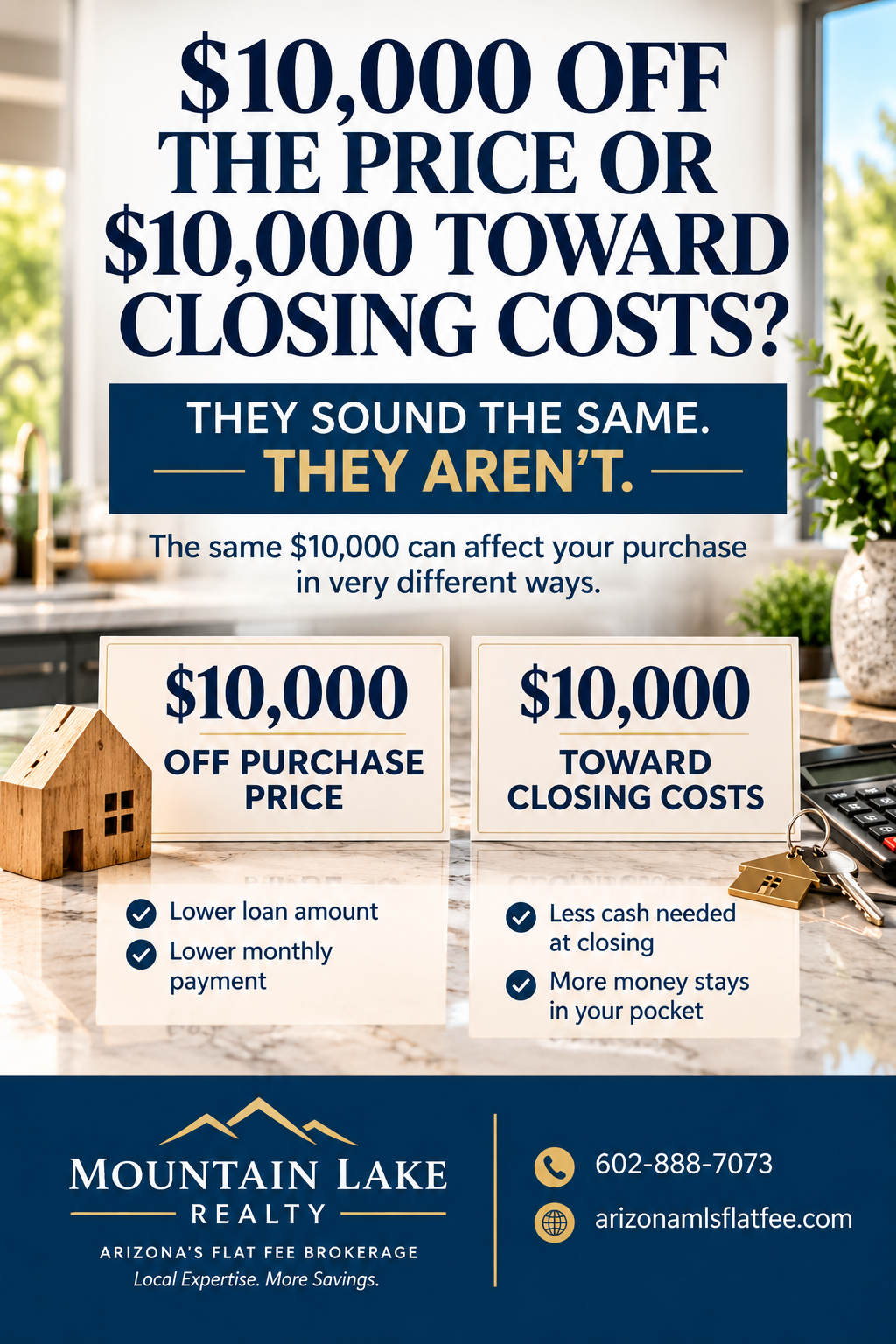
$10,000 Off the Purchase Price vs. $10,000 Toward Closing Costs: What\'s the Difference?
A $10,000 price reduction and a $10,000 closing-cost credit are not the same thing. Here is how each option affects Arizona homebuyers differently.

When buying a home, a $10,000 seller concession can sound the same whether it is used to reduce the purchase price or help pay the buyer's closing costs.
But these two options can affect your home purchase in very different ways.
For Arizona homebuyers, understanding the difference between $10,000 off the purchase price and $10,000 toward closing costs can help you determine which option provides the greater financial benefit.
$10,000 Off the Purchase Price
Suppose a home is listed for $500,000, and the seller agrees to reduce the price by $10,000.
Your new purchase price becomes: $490,000
The immediate advantage is that you are borrowing against a lower purchase price.
For example, with a conventional mortgage requiring 20% down:
| Original | With $10K reduction | |
|---|---|---|
| Purchase price | $500,000 | $490,000 |
| 20% down payment | $100,000 | $98,000 |
| Mortgage | $400,000 | $392,000 |
That means the buyer needs $2,000 less for the down payment and finances $8,000 less. A lower loan balance can also mean a slightly lower monthly mortgage payment.
But there is an important consideration: a $10,000 price reduction does not necessarily put $10,000 of cash back into the buyer's pocket at closing. The savings are primarily reflected in the lower purchase price, lower loan amount, and potentially lower monthly payment.
$10,000 Toward Closing Costs
Now consider a $500,000 home where the seller agrees to provide a $10,000 credit toward the buyer's allowable closing costs.
The purchase price remains $500,000. But the buyer may use the seller credit toward eligible expenses associated with the purchase, subject to the mortgage program, lender rules, and applicable limits.
Depending on the buyer's situation, these expenses could include items such as:
- Loan costs
- Title and escrow expenses
- Prepaid taxes
- Insurance
- Other allowable closing expenses
The major advantage is cash preservation. Instead of bringing as much money to the closing table, the buyer may be able to use the seller contribution to cover eligible costs.
If a buyer has enough money for the down payment but is concerned about having sufficient cash for closing, a seller credit can be considerably more useful than a price reduction.
Which Is Better: Price Reduction or Closing-Cost Credit?
There is no universal answer. The better option depends on the buyer's financial situation.
A $10,000 price reduction may make more sense if:
- You want a lower purchase price
- You want to reduce the mortgage balance
- You want a slightly lower monthly payment
- You have sufficient cash available for closing
- Your primary goal is reducing the long-term loan amount
A $10,000 closing-cost credit may make more sense if:
- You want to preserve cash
- You have enough money for your down payment but need help with closing expenses
- You want to reduce the amount of money required at closing
- You have allowable closing costs that can absorb the credit
The Difference Can Be Bigger Than It Looks
Consider two buyers purchasing the same $500,000 Arizona home.
- Buyer A negotiates $10,000 off the purchase price — receives a lower loan balance and slightly lower monthly payment.
- Buyer B negotiates $10,000 toward allowable closing costs — retains thousands of dollars that otherwise would have been needed for closing expenses.
The right choice depends on the buyer's loan type, down payment, available cash, closing costs, interest rate and long-term plans.
What About Interest Rates?
Instead of simply reducing the purchase price or paying closing costs, a seller concession may sometimes be structured to help with an interest-rate buydown, depending on the loan program and lender requirements.
For example, a temporary rate buydown could reduce the buyer's mortgage payment during the early years of the loan. However, buyers should compare the actual numbers rather than assuming a rate buydown is automatically better.
Ask the lender to show you the monthly payment, total interest, loan balance, cash required at closing, cost of the buydown, and long-term savings.
Important: Seller Credits Have Rules
Buyers cannot always receive a $10,000 seller credit simply because the seller agrees to it.
Mortgage programs and lenders have rules governing seller concessions and allowable closing costs. The amount that can be credited can depend on factors including the type of mortgage, down payment, occupancy and other transaction details.
Also, a seller credit generally cannot simply be converted into cash back to the buyer beyond what is permitted under the applicable loan rules.
That is why buyers should have their lender and escrow/title company confirm exactly how a proposed seller concession can be used before negotiating the final terms.
Don't Look Only at the Purchase Price
When negotiating an Arizona home purchase, buyers sometimes focus entirely on the sales price. But the better question may be: "What structure gives me the greatest financial benefit?"
A $10,000 reduction in price and a $10,000 contribution toward allowable closing costs may have very different effects on your finances. One can reduce the amount you finance. The other can reduce the amount of cash you need at closing.
And depending on your circumstances, preserving cash may be more valuable than reducing the purchase price.
How to negotiate the right concession for your situation
Understanding the difference between a price reduction and a closing cost credit is only the first step. The next step is knowing how to negotiate effectively.
Start by knowing your numbers
Before you make an offer or respond to a counteroffer, ask your lender to run both scenarios:
-
$10,000 price reduction: What is the new monthly payment? How much less do you need for the down payment? What is the total interest savings over the life of the loan?
-
$10,000 closing cost credit: How much cash do you save at closing? What are your total closing costs, and how much of the credit can actually be applied?
Your lender can model both scenarios in minutes. The numbers will tell you which option is more valuable for your specific situation.
Consider your cash position
If you have plenty of cash for both the down payment and closing costs, a price reduction may be more valuable — it reduces your loan balance and your monthly payment.
If you are stretching to cover closing costs, a seller credit may be more valuable — it preserves cash that you need at closing.
If you are in between, ask your lender to model both scenarios and compare the total cost of each option over a 5-year and 10-year horizon.
Understand the seller's perspective
Sellers often prefer a price reduction over a closing cost credit because it keeps the purchase price intact for the appraisal. A closing cost credit reduces the seller's net proceeds but does not affect the appraised value.
If a seller is resistant to a closing cost credit, you might offer to accept a slightly lower credit in exchange for keeping the purchase price at the seller's preferred level. For example, instead of asking for $10,000 toward closing costs, you might ask for $8,000 — a smaller concession that may be easier for the seller to accept.
The rate buydown alternative
In a high-rate environment, a seller-funded rate buydown can be more valuable than either a price reduction or a closing cost credit.
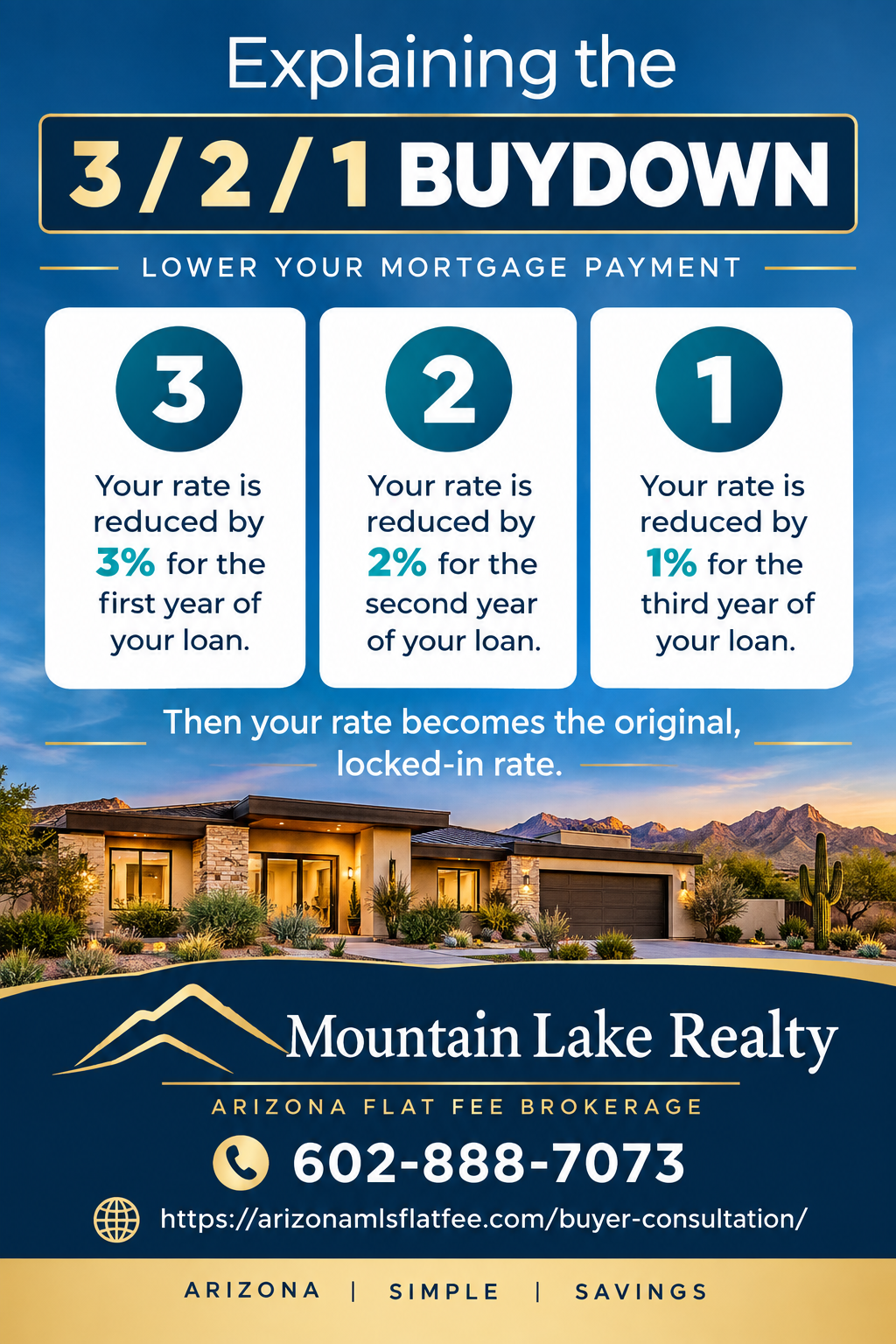
A 2-1 buydown reduces your interest rate by 2% in year one and 1% in year two, then returns to the note rate in year three. On a $400,000 loan at 7%, a 2-1 buydown might cost the seller $8,000–$12,000 but save you $400–$600 per month in the first two years.
Whether a buydown makes more sense than a price reduction or closing cost credit depends on:
- How long you plan to stay in the home
- Your current cash position
- Whether you expect to refinance when rates drop
- The specific cost of the buydown vs. the savings
Ask your lender to model the buydown scenario alongside the price reduction and closing cost credit scenarios before deciding.
Arizona-specific considerations
Closing costs in Arizona typically run 1.5–3% of the purchase price, depending on the loan type, lender fees, and title/escrow costs. On a $450,000 home, that is $6,750–$13,500. A seller credit of $8,000–$10,000 can cover a significant portion of these costs.
Arizona uses escrow companies (not attorneys) to handle closings. The escrow company will confirm exactly how a seller credit can be applied and will ensure that the credit is properly documented in the closing disclosure.
HOA transfer fees are common in Arizona and are typically paid by the seller, but can sometimes be negotiated. If you are buying in an HOA community, ask about transfer fees and whether they can be included in a seller concession.
Property taxes in Arizona are paid in arrears, which means the seller will typically credit the buyer for the portion of the year's taxes that have accrued before closing. This is separate from a seller concession and is a standard part of the closing process.
The bottom line: a $10,000 concession is not always $10,000. How it is structured — price reduction, closing cost credit, or rate buydown — can make a significant difference in your monthly payment, your cash at closing, and your long-term financial outcome. Run the numbers with your lender before you negotiate.
Related reading:
- How Much Should I Reduce My Home Price After 30 Days? — when and how much to reduce
- Arizona Seller Closing Costs: What to Budget — full breakdown of what sellers pay at closing
- Are Adjustable-Rate Mortgages a Smart Move for Arizona Buyers? — understanding buyer financing options
- 3-2-1 Buydown Arizona: How Home Buyers Can Lower Mortgage Payments — how rate buydowns work
- Flat Fee MLS Arizona: The Complete Guide — how to list your Arizona home for less
Explore Topics
Written by
Dash List Team
Content creator and writer sharing insights and stories.